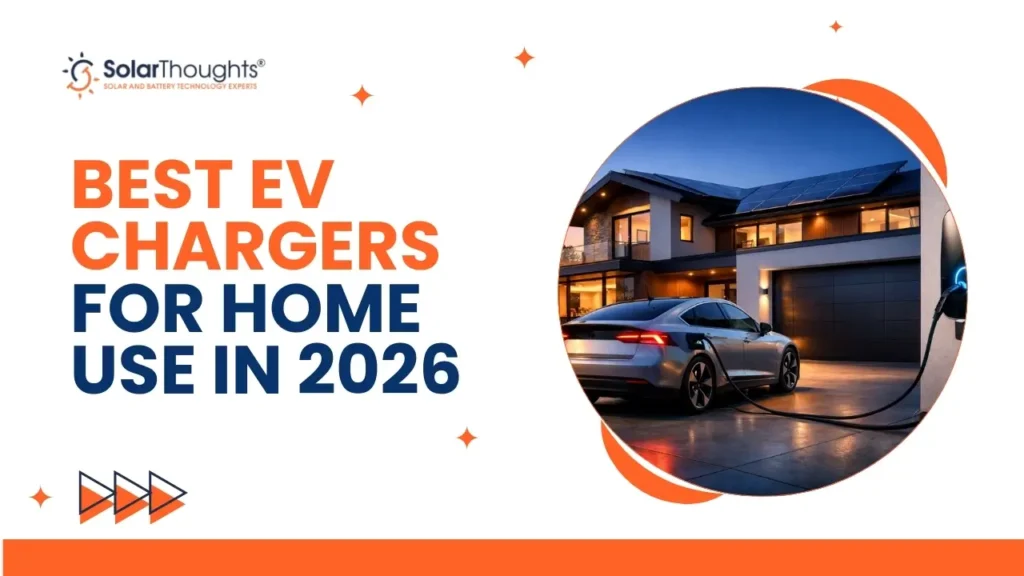
Most EV owners charge their car at home. It’s cheaper than public charging, easier to manage, and fits naturally into daily life. However, once you start looking for a home charger, things can become confusing quickly. There are dozens of options, wildly different prices, and plenty of bold claims about “smart features” and “future-proof tech”.
Table of Contents
ToggleAt SolarThoughts®, we look at EV chargers from a practical point of view. What actually works long term? What stays reliable in heat? And what makes sense if your home already has solar?
This guide breaks it all down in plain terms, so you can choose a charger that suits your home, not just the marketing brochure.
Why Cheap Portable Chargers Aren’t a Good Long-Term Choice
A lot of new EV owners start with a cheap portable charger they find online. These units are usually advertised as simple, plug-and-play solutions and cost a fraction of a wall charger.
They’re fine as a backup. They are not fine as your main charging setup.
Portable chargers are designed for occasional use. Charging an EV puts a constant load on the electrical system for many hours at a time. Cheap units often use lower-grade internal components, thinner cables, and basic temperature protection. Over time, that combination becomes risky.
If you rely on one every night, you’re asking a standard power outlet to do a job it was never designed for.
Using Wall Power Points: Where Problems Start
Standard 10-amp and 15-amp power points are built for short bursts of use. A kettle, vacuum, or toaster runs for minutes. An EV charger runs flat-out for hours.
That difference matters.
When a power point is under continuous load, the internal contacts heat up. Over months or years, they can loosen, burn, or fail. In some cases, this has led to melted outlets and house fires.
Shared Circuits Make It Worse
Most garages don’t have a dedicated circuit. The same wiring might also feed bedrooms, lights, or other appliances. If someone turns on a heater while the car is charging, the circuit can trip. Worse, the wiring may overheat inside the wall before the breaker reacts.
A proper EV charger avoids all of this by running on its own circuit with its own breaker. That’s not just convenient — it’s safer.
Why Wall-Mounted EV Chargers Are Worth It
A wall-mounted EV charger is designed specifically for long charging sessions. It’s permanently wired, properly protected, and built to handle high loads without stress.
Once installed, it’s also far easier to live with. You plug in, walk away, and know the car will be charged in the morning.
Most modern chargers also include smart features, which can make a real difference if you’re on time-of-use tariffs or have solar panels.
Solar and Smart Charging: Where the Savings Are
If your home has solar, a smart charger can save you serious money.
Instead of pulling power from the grid at night, the charger can soak up excess solar during the day. Some chargers automatically slow down or speed up based on how much solar your system is producing. Others let you schedule charging for cheap tariff windows.
The key thing is compatibility. Not every charger talks to every solar system in the same way. Some use hard-wired monitoring. Others rely on cloud data. Choosing the wrong match can mean paying extra for third-party apps or losing features altogether.
This is where good advice matters.
Heat, Reliability, and Real-World Performance
Australian summers are unforgiving. A charger that looks great on paper can fall apart once it’s mounted in a hot garage.
Poor thermal design causes chargers to protect themselves by slowing down their operation. On a hot day, that can mean charging at a fraction of the expected speed. You wake up with a half-charged car and no clear explanation why.
Reliability beats fancy features every time. A charger that quietly does its job in the heat is far better than one with screens, lights, and menus that can’t handle real conditions.
Choosing the Right Charger for Your Home
There’s no single “best” EV charger for everyone. The right choice depends on your car, your electrical setup, and whether solar is part of the picture.
General guidance from SolarThoughts®:
- Install a dedicated wall charger for daily use
- Make sure it runs on its own circuit.
- Prioritise build quality and heat resistance.
- If you have solar, choose a charger that can actually work with it properly.
- Keep portable chargers as emergency backups only.
Be cautious of chargers with a history of overheating, slowdowns, or frequent warranty claims. A charger that drops to low power on a warm afternoon isn’t doing you any favours.
Final Thoughts
Home EV charging should be boring — in a good way. You plug in, go inside, and forget about it. The charger should work quietly, safely, and consistently for years.
Cheap solutions often cost more in the long run. A well-installed, well-matched charger protects your home, your car, and your power bill.
At SolarThoughts®, we always recommend focusing on reliability first, solar compatibility second, and features last. If you get those right, everything else falls into place.If you’re planning EV charger installation in Brisbane, speak with someone who understands both EV charging and solar systems. The right advice now can save you expensive upgrades later.
Our Popular Services
Solar panels Brisbane | Solar Panel Installation Services | Upgrading existing Solar system | Solar Panel Repairs and Maintenance | Solar Panel Cleaning Service | Solar Battery Installations | Solar Inverter Installations