Get the size wrong and you either overpay for power you can’t use, or run short and keep buying from the grid. Getting it right is the single biggest factor in how much you save.
So what size solar system do I need? This guide shows you how to work it out from your power bill, your roof, and how you actually use energy, with clear 2026 examples for Australian homes.
Key Takeaways
- Most Australian homes suit a 6.6 kW to 10 kW system, with 6.6 kW the most popular choice.
- The right size comes from your daily kWh usage, your roof space, and your future plans.
- A simple formula: daily kWh, times 1.25, divided by your peak sun hours, gives a solid starting size.
What Size Solar System Do I Need?
For most Australian homes, the answer is a system between 6.6 kW and 10 kW. A 6.6 kW system is the most popular, because it suits typical usage, fits a standard single-phase connection, and qualifies for the maximum government rebate.
But “most homes” isn’t your home. The right size depends on how much electricity you use, when you use it, and how much roof you have. Let’s work out your number.
How to Calculate Your Ideal System Size
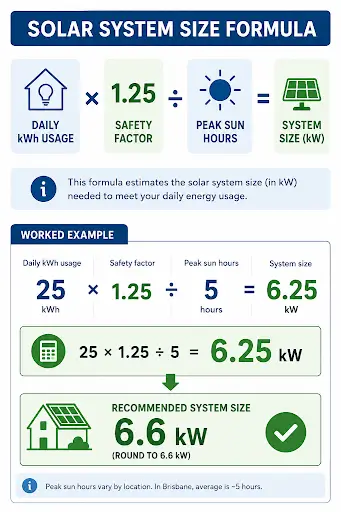
Start with your electricity bill. Find your average daily usage in kilowatt-hours (kWh). Most Australian homes use between 12 and 30 kWh per day.
Then use this rough formula:
System size (kW) = daily kWh usage × 1.25 ÷ peak sun hours
Brisbane gets around 5 peak sun hours a day. So a home using 25 kWh daily would need about (25 × 1.25 ÷ 5) = 6.25 kW, which rounds up to a standard 6.6 kW system.
Using a full 12 months of usage is more accurate than one bill, since summer air-con and winter heating differ a lot.
System Sizes by Household
Here’s a practical guide based on typical Australian homes:
| Household | Daily usage | Suggested system |
|---|---|---|
| 1 to 2 people, small home | 8 to 14 kWh | 6.6 kW |
| 3 to 4 people, average home | 15 to 25 kWh | 6.6 to 10 kW |
| 5+ people, pool or air-con | 25 to 40 kWh | 10 to 13.2 kW |
| EV, all-electric, or home office | 30 kWh+ | 13.2 to 19.8 kW |
Indicative sizing based on Australian household averages. Source: energy.gov.au.
Once you know your range, explore the options: our 6.6 kW, 10.56 kW, 13.2 kW, and 19.8 kW system pages break down each one.
When You Use Power Matters Most
Here’s something most people miss. A solar system only generates during the day, so your daytime usage drives the value, unless you add a battery.
If your home is empty until evening, much of your solar gets exported for just a few cents. You can fix this two ways. Shift loads like the dishwasher, washing machine, and pool pump to daylight hours, or add a battery to store the surplus for the evening.
Planning a battery? Size your panels a little larger so there’s enough generation to charge it. Our guide on choosing the right solar battery size pairs well with this.
Pro tip: When in doubt, size up slightly. Panels are the cheapest part per watt, and homes almost always use more power over time, not less.
Roof Space and Phase Considerations
Two practical limits can shape your choice.
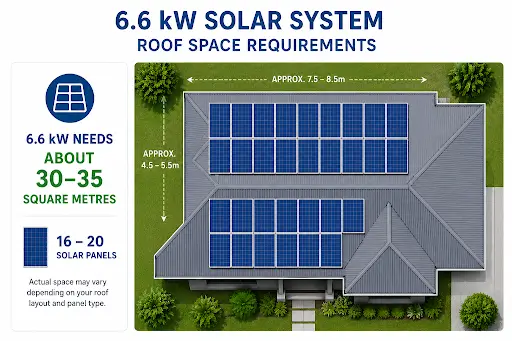
Roof space. A 6.6 kW system needs roughly 30 to 35 m² of unshaded roof, around 16 to 20 panels. Shading from trees or chimneys cuts output, so panel placement matters.
Single vs three phase. A standard single-phase home can usually take up to about 6.6 kW on one inverter. Going bigger may mean a three-phase connection or a dual-inverter setup. Our guide on single phase vs three phase explains the difference.
Not sure what your roof can handle? Book a free system design with SolarThoughts® and we’ll size it to your home and budget.
Common Mistakes to Avoid
Sizing off one quarterly bill. Use a full year so seasonal swings don’t skew your number.
Ignoring future plans. An EV, a pool, or going all-electric all push your usage up. Plan for it.
Going too small to save money. An undersized system leaves you buying expensive grid power for years.
Forgetting daytime use. Without a battery, solar only offsets what you use while the sun’s up.
Overlooking shading. Even partial shade can drag down a well-sized system’s output.
Frequently Asked Questions
Most Australian homes suit 6.6 kW to 10 kW. Size it from your daily kWh usage, roof space, and future plans.
Multiply your daily kWh usage by 1.25, then divide by your peak sun hours, around 5 in Brisbane.
For many homes, yes. It suits 15 to 25 kWh a day and qualifies for the maximum rebate.
Around 16 to 20 panels, depending on panel wattage, needing roughly 30 to 35 m² of roof.
Yes. Upsize your panels so there’s enough generation to charge the battery and cover daytime use.
EV homes often suit 10 kW or larger to cover the extra charging load on top of household use.
About 30 to 35 m² for a 6.6 kW system. Larger systems need proportionally more unshaded roof.
Often up to around 6.6 kW per inverter. Larger systems may need three phase or two inverters.
Yes. Shaded roofs produce less, so you may need more panels or panel-level optimisers.
6.6 kW, because it balances output, cost, roof space, and rebate eligibility for most homes.
Conclusion
So what size solar system do I need? For most Australian homes the answer lands between 6.6 kW and 10 kW, sized from your daily kWh usage, your roof, and your future plans like an EV or a battery.
Run the simple formula, think about when you use power, and size up slightly if you’re unsure. Get it right and your system delivers maximum savings for decades.
Ready to find your perfect fit? Contact SolarThoughts® for a free, tailored system design and we’ll match the right size to your home.