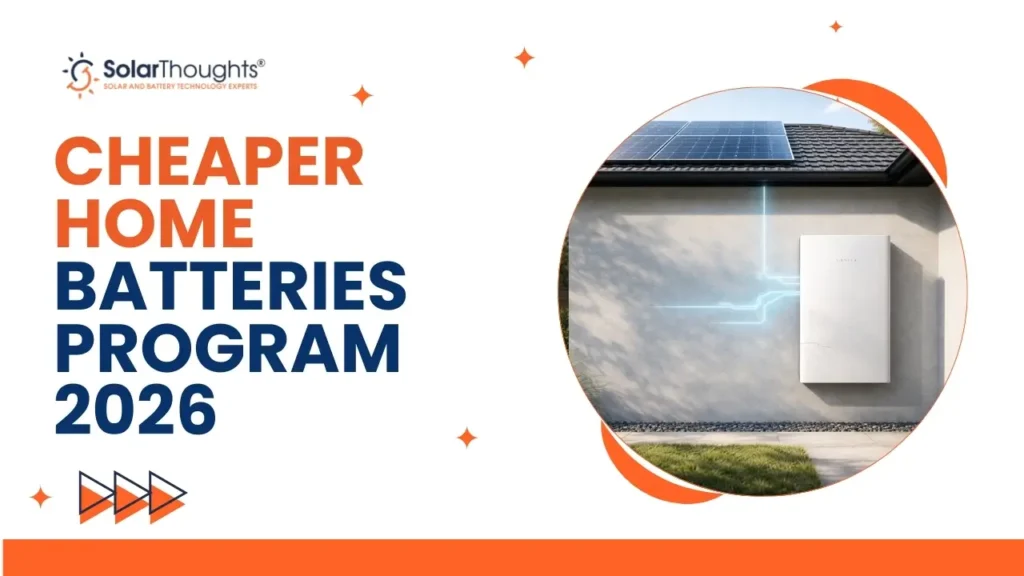
Home batteries finally make financial sense for many Australian households in 2026. With feed-in tariffs falling, evening electricity prices rising, and battery costs dropping, storing your own solar power is often cheaper than buying electricity back from the grid.
Table of Contents
ToggleTo accelerate this shift, the Australian Government has introduced the Cheaper Home Batteries Program, making battery storage more affordable for homes, businesses, and community organisations.
At SolarThoughts®, we focus on how these programs work in real Australian homes—not just policy documents.
What Is the Cheaper Home Batteries Program?
The Cheaper Home Batteries Program is a government-backed initiative that provides around 30% off the upfront cost of eligible home battery systems.
The discount applies to:
- Battery systems from 5 kWh up to 100 kWh
- Batteries connected to new or existing solar systems
- Residential homes, businesses, and community organisations
The program is delivered through the Small-scale Renewable Energy Scheme (SRES) and administered by the Clean Energy Regulator (CER).
Why This Program Matters
Australia leads the world in rooftop solar adoption, with more than 4.2 million solar systems installed. However, until recently, battery uptake lagged behind due to high upfront costs.
Thanks to this program:
- Battery ownership has increased from 1 in 40 households to 1 in 24
- More homes can store solar energy for evening use
- Pressure on the electricity grid during peak demand is reduced
In simple terms: batteries are no longer just for early adopters.
How Much Is the Discount?
The discount is:
- Funded by the government, not energy retailers
- Based on your battery’s usable capacity
- Calculated using Small-scale Technology Certificates (STCs)
The value of the discount:
- Is reviewed at least annually
- Will gradually reduce until 2030 as battery prices fall
Eligibility depends on meeting requirements under the Renewable Energy (Electricity) Regulations 2001.
How Do You Access the Battery Discount?
Option 1: Through an Accredited Installer (Most Common)
You don’t need to apply directly.
When you install through an accredited retailer or installer:
- The discount is usually applied upfront, or
- Provided as a rebate after installation
If there’s ever an issue, the Clean Energy Regulator can assist.
Option 2: Claim STCs Yourself (Advanced Users)
You can choose to:
- Keep the right to create STCs
- Trade them via the REC Registry
This option suits experienced buyers and requires more paperwork.
Important Changes from 1 May 2026
The government has expanded funding for the program from $2.3 billion to $7.2 billion, aiming to support over 2 million battery installations by 2030.
What’s Changing?
1. STC Values Will Decline Faster
- STC values will reduce every 6 months
- The rate of decline will be higher than before
| Year | Period | STC Factor |
|---|---|---|
| 2026 | Jan–Apr | 8.4 |
| 2026 | May–Dec | 6.8 |
| 2027 | Jan–Jun | 5.7 |
| 2027 | Jul–Dec | 5.2 |
| 2028 | Jan–Jun | 4.6 |
| 2028 | Jul–Dec | 4.1 |
| 2029 | Jan–Jun | 3.6 |
| 2029 | Jul–Dec | 3.1 |
| 2030 | Jan–Jun | 2.6 |
| 2030 | Jul–Dec | 2.1 |
This means earlier installations receive higher discounts.
2. Support Will Taper for Larger Batteries
From May 2026:
- First 14 kWh → 100% STC value
- 14–28 kWh → 60% STC value
- 28–50 kWh → 15% STC value
This structure keeps the discount fair while reflecting falling battery prices.
Batteries Are Now Part of the SRES
Previously, the SRES supported only solar panels. The Cheaper Home Batteries Program expands this proven framework to include batteries.
This ensures:
- Products are CEC-approved
- Installers are SAA-accredited
- Systems meet strict safety and compliance standards
For homeowners, this means strong consumer protection.
Can This Be Combined With Other Rebates?
Yes. The program is designed to work alongside state and territory incentives.
You may also be eligible for:
- State battery rebates
- Discounted finance via the Household Energy Upgrades Fund
Eligibility depends on your state and system design.
Expert Tip
Not every home benefits equally from a battery.
Before installing, you should consider:
- Your daily energy usage
- Solar system size and inverter limits
- Whether your home is single-phase or three-phase
- Future plans like EV charging or air conditioning upgrades
A battery that’s too large—or too small—can reduce financial returns.
Conclusion
The Cheaper Home Batteries Program makes battery storage more accessible than ever—but the right system design matters more than the rebate itself.
At SolarThoughts®, we help homeowners:
- Check eligibility
- Size batteries correctly
- Maximise savings under current STC levels
- Future-proof their energy setup
Thinking about installing a home battery in Brisbane or Ipswich? Contact SolarThoughts® today for honest advice on battery rebates, system sizing, and whether the Cheaper Home Batteries Program works for your home.
Our Popular Services
Solar panels Brisbane | Solar Panel Installation Services | Upgrading existing Solar system | Solar Panel Repairs and Maintenance | Solar Panel Cleaning Service | Solar Battery Installations | Solar Inverter Installations