You spent thousands on a solar battery. The installer drove away. The app lit up green. And then nothing. You assumed it would just take care of itself.
Table of Contents
ToggleHere is what most installers forget to tell you. A solar battery is low maintenance but it is not zero maintenance. Ignoring it completely is one of the most common reasons Brisbane homeowners end up with a battery that degrades faster than it should, loses capacity earlier than expected, and fails to deliver the savings it promised.
This solar battery maintenance guide gives you the complete picture. What to check, how often, what warning signs to watch for, and when to call a professional. Whether you have a Tesla Powerwall, Sungrow, BYD, or any other system installed across Brisbane, the Gold Coast, Ipswich, or the Sunshine Coast, this guide applies to you.
Why Solar Battery Maintenance Matters More Than You Think
Most quality lithium iron phosphate (LFP) batteries installed in Brisbane today are warranted for 10 years, with some brands guaranteeing up to 15 years of usable life. But a warranty is the floor, not the ceiling. Properly maintained batteries regularly outlast their warranty periods. Poorly maintained ones do not always reach them.
Here is what happens when maintenance is ignored:
- Thermal stress from poor ventilation accelerates capacity loss
- Firmware left unupdated causes charging inefficiencies and missed performance improvements
- Loose electrical connections degrade over time and create safety risks
- Undetected faults in the Battery Management System go unresolved and compound
According to energy.gov.au, regular inspection and maintenance of your solar battery system is strongly recommended to protect both performance and safety. And in Brisbane’s subtropical climate, with hot summers, storm humidity, and intense UV, this advice matters more than it does in cooler states.
Step 1: Get the Placement and Ventilation Right From Day One
This is not something you can fix with an app. Where your battery is mounted has more impact on its lifespan than any other maintenance decision you will ever make. If your battery was installed in a poor location, it is worth having it assessed and potentially relocated before the damage compounds.
What the ideal placement looks like:
- Temperature: Lithium batteries operate best between 10 and 30 degrees Celsius. Brisbane summers regularly push garages past 50 degrees. That sustained heat accelerates degradation with every charge cycle.
- Direct sunlight: Never install a battery on a west-facing external wall in direct afternoon sun. Shade is not optional in Queensland, it is essential.
- Ventilation clearance: Most manufacturers require at least 200mm of clear space around the unit. Cluttered garages with tight placements restrict airflow and trap heat.
- Away from water sources: Coastal properties on the Gold Coast and Sunshine Coast face salt air, a major enemy of electrical connections. Position batteries away from sprinklers, drainage, or flood-prone areas.
- Garage bollards: If your battery is in a garage, fit steel bollards in front of it. Even a slow-speed car bump can cause significant damage to the casing or internal components.
A battery mounted on a west-facing wall in direct afternoon sun in Ipswich or the Gold Coast can experience surface temperatures 15 to 20 degrees higher than ambient air temperature. Over a 10-year lifespan, that thermal stress compounds into measurable capacity loss. If your battery is in this position, raise it with your installer at your next check.
Step 2: Weekly and Monthly Checks You Can Do Yourself
The good news is that most of the regular maintenance on a modern solar battery takes less than five minutes and requires no tools. Here is exactly what to do and how often.
Weekly: Check Your Monitoring App
Every solar battery sold in Australia today comes with a companion app, whether that is the Tesla app, mySolarPower (Sungrow), or your inverter manufacturer’s portal. Open it once a week and check:
- Battery state of charge at the same time each day. Is it charging and discharging consistently?
- Daily energy is stored and released. Does it match your expectations for the season?
- Operating temperature. Anything above 40 degrees warrants attention.
- Any alerts or warning notifications. Do not dismiss these without investigating them.
Monthly: Visual Inspection
A quick monthly walk-past of your battery takes two minutes and can catch issues early. Look for:
- Any corrosion, rust, or discolouration around cable entry points
- Cables that appear loose, kinked, or showing signs of wear
- Unusual smells. A chemical or burning odour is a serious warning sign.
- Any physical damage to the casing such as dents, cracks, or swelling
- Dust and debris build-up on the casing. Wipe down with a dry cloth only, never water or chemical cleaners.
Every 6 Months: Check Ventilation Clearance
Garages accumulate clutter over time. Storage boxes, bikes, tools, and household overflow tend to migrate toward the battery wall. Every six months, check that the required clearance space around your battery is still clear and airflow is unobstructed.
Your Complete Solar Battery Maintenance Checklist
Print this out and stick it near your switchboard. Tick each task off as you complete it.
| Frequency | Task | What to Look For |
| Weekly | Check monitoring app | Output levels, charge %, temperature alerts |
| Monthly | Visual inspection | Corrosion, damage, loose cables, unusual odours |
| Monthly | Clean battery casing | Dust build-up only. Use a dry cloth, no water |
| Every 6 months | Check ventilation clearance | Minimum 200mm clear space around the unit |
| Annually | Professional inspection | Connections, BMS health, capacity test, firmware |
| Annually | Test blackout backup | Turn off main switch, confirm backed-up circuits work |
Source: Recommendations compiled from manufacturer guidelines, Clean Energy Council standards, and Australian Standard AS5139 for Battery Energy Storage Systems.
Step 3: Annual Professional Inspection and What It Covers
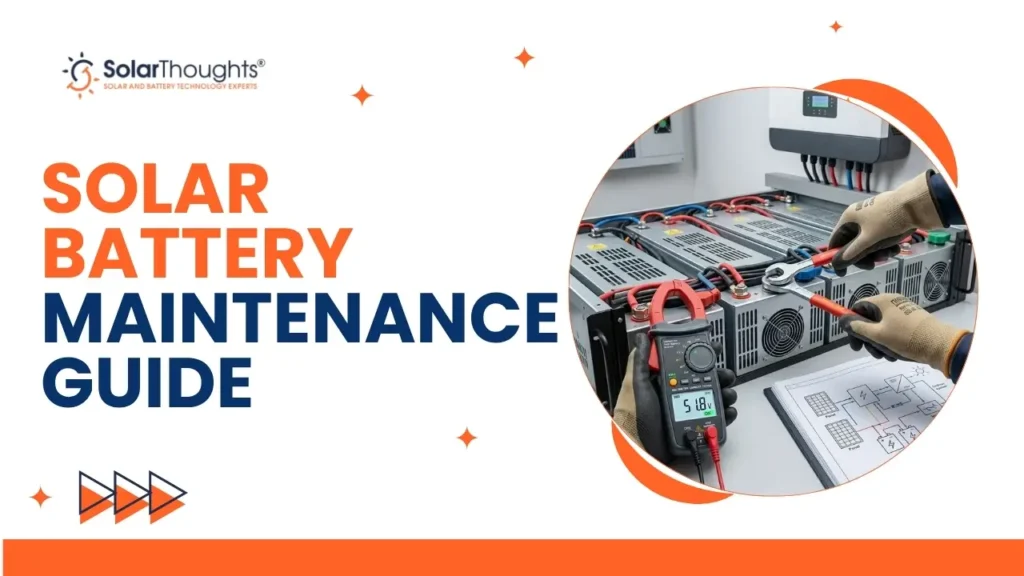
Your weekly app checks and monthly visual inspections are valuable. But once a year, a qualified CEC-accredited technician should inspect the system in a way no app can replicate. Here is what a proper annual professional inspection covers:
- Electrical connections: Torque-check all terminals and connections. Vibration, thermal cycling, and general settlement can loosen connections over time, creating resistance and potential arc risk.
- BMS health check: The Battery Management System controls charging, discharging, temperature regulation, and cell balancing. A professional can interrogate BMS logs for fault codes you would never see in the consumer app.
- Capacity test: Measures how much energy your battery can actually store compared to its rated specification. Capacity naturally declines over time and a good installer tracks this year over year.
- Firmware update: Most major brands, including Tesla, Sungrow, and BYD, release firmware updates that improve performance, fix bugs, and address safety issues. These must be applied by a qualified installer.
- Blackout test: Your installer should confirm that your blackout backup circuits work as expected. Turn off the main grid switch and check which circuits stay live. Many homeowners have never tested this.
- Full system report: A professional inspection should produce a written report with current performance data, any issues found, and recommendations. Keep these for warranty claims.
| Important: Under Australian Standard AS5139, battery energy storage systems must be installed and serviced by qualified professionals. DIY work on battery systems can void your warranty and your home insurance. Always use a CEC-accredited installer for anything beyond visual checks and app monitoring. |
Warning Signs Your Solar Battery Needs Immediate Attention
Do not wait for your annual inspection if you notice any of the following. These are signs that something may be wrong right now:
- Capacity has dropped sharply: If your battery is discharging significantly faster than before on the same usage pattern, this indicates cell degradation or BMS issues.
- Battery not charging fully: Consistently failing to reach 100% charge when solar generation should be sufficient is a warning sign worth investigating.
- Unusual noises: Clicking, buzzing, or humming from the battery unit that was not there before.
- Chemical smell: Any odour near the battery, especially a sweet, chemical, or burning smell, warrants immediate attention and a call to your installer.
- Swelling or physical distortion: Visible swelling of the battery casing is a safety emergency. Stop using the system and call your installer immediately.
- Persistent app errors: Repeated fault codes, temperature warnings, or connection failures that do not self-resolve.3
The Clean Energy Council recommends contacting your installer immediately if you notice any physical changes to your battery or persistent error alerts. Do not attempt to investigate internal faults yourself.
5 Simple Habits That Extend Your Battery Lifespan
Beyond scheduled maintenance, these everyday habits make a real difference to how long your battery lasts and how well it performs:
- Avoid consistently charging to 100%: Most battery management systems let you set a charge limit. 90% is often recommended as a daily maximum. Keeping the battery at 100% for extended periods creates micro-stress on the cells.
- Avoid deep discharging regularly: Repeatedly discharging below 20% accelerates cell degradation in most lithium chemistries. Set your battery minimum reserve to 20% or higher for daily cycling.
- Maximise shade and airflow around the unit: If your garage is getting hotter each summer, consider whether improved ventilation or repositioning the unit is worth the investment.
- Keep software updated: When your installer notifies you of a firmware update, prioritise it. Updates often include important charging algorithm improvements, not just cosmetic changes.
- Use your monitoring data: Download monthly reports from your app and compare them over time. A gradual trend of declining output is much easier to address early than after significant capacity loss.
Frequently Asked Questions
How often should I service my solar battery?
Check your app weekly, do a visual inspection monthly, and book a professional annual service.
Can I maintain my solar battery myself?
Yes. App monitoring, visual checks, and casing wipe-downs are DIY-friendly. Electrical work needs a licensed technician.
How long does a solar battery last in Brisbane?
Most quality LFP batteries last 10 to 15 years in Brisbane. Good maintenance and cool placement extend this.
What temperature should my solar battery be kept at?
Between 10 and 30 degrees Celsius is ideal. In Brisbane, shade and ventilation are essential, not optional.
Will skipping maintenance void my warranty?
It can. Most brands require professional servicing records. Always keep annual inspection reports as proof.
Conclusion
Your solar battery maintenance guide does not need to be complicated. Check your app every week. Do a visual inspection every month. Book a professional once a year. Keep it cool, ventilated, and out of direct sun, especially in Brisbane’s summers.
Follow those simple steps and your battery will deliver the performance and savings it promised, year after year. Skip them and you risk paying for a replacement years before you should have to.
Do not wait for a fault alert to be the reason you finally call. Be proactive and your battery and your power bill will thank you for it. Contact SolarThoughts today for a free in-home battery assessment from Brisbane’s CEC-accredited solar experts.
Our Popular Services
Solar panels Brisbane | Solar Panel Installation Services | Upgrading existing Solar system | Solar Panel Repairs and Maintenance | Solar Panel Cleaning Service | Solar Battery Installations | Solar Inverter Installations