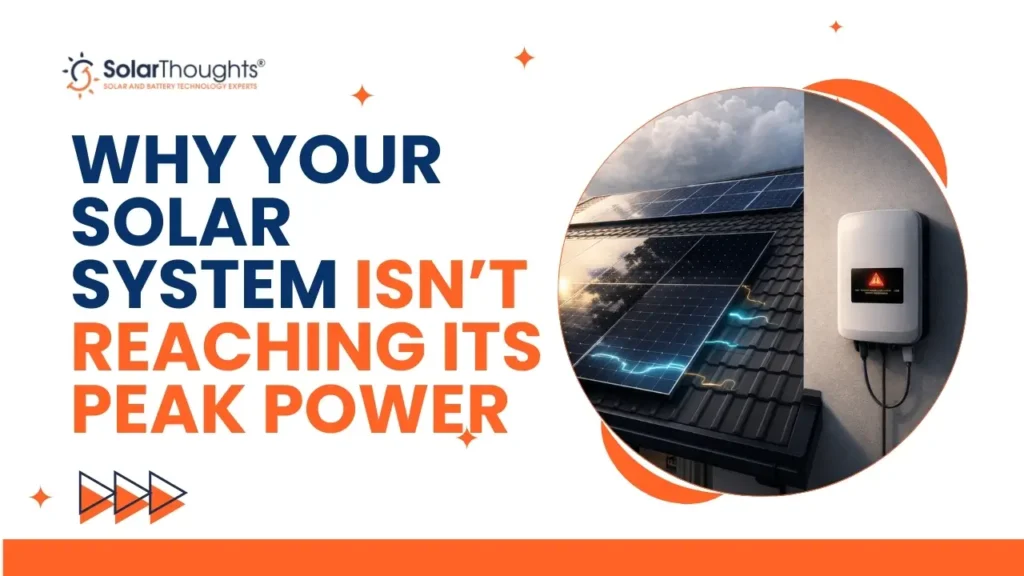
At SolarThoughts®, we regularly speak with homeowners who feel disappointed after installing solar. You might have invested in 13 kW of panels paired with a 10 kW inverter, yet when you check your monitoring app at midday, the system rarely hits that maximum number.
Table of Contents
ToggleIt’s easy to assume something isn’t working properly. In reality, most of the time, your solar system is doing exactly what it should.
Peak power isn’t the best measure of solar performance. Understanding how solar energy behaves throughout the day and across seasons makes all the difference.
Kilowatts vs Kilowatt Hours: The Key Difference Most People Miss
This confusion sits at the heart of most solar concerns.
- Kilowatts (kW) show how much power your system is producing at one specific moment — like a car’s speed.
- Kilowatt hours (kWh) show how much total energy your system produces over time, as the total distance travelled.
Solar systems are designed to meet daily and monthly energy targets, not to sit at maximum output for long periods. What matters most is how many kilowatt hours your system delivers, because that’s what reduces your electricity bill.
At SolarThoughts®, we always encourage homeowners to focus on total energy production, not momentary peaks.
Why North-Facing Solar Systems Perform Best
Roof direction has a major impact on output.
In South-East Queensland and similar regions, north-facing panels perform best overall. A roof pitch close to 27 degrees captures both summer and winter sunlight efficiently.
With 13 kW of north-facing panels, most systems will:
- Reach the inverter limit for several hours in summer
- Briefly touch peak output in winter when the sun is lower.
This is why north-facing systems tend to meet expectations more easily.
The Reality of East–West Solar Systems
Many modern homes use east–west panel layouts, especially where north roof space is limited. These systems behave differently — but not poorly.
Instead of one sharp midday peak, energy production is spread across the morning and afternoon.
Typical winter performance for a 13 kW system on a 10 kW inverter:
- Midday peak around 7.2 kW
- Strong energy production across the full day
This setup is often ideal for households that use power before work and again in the late afternoon.
Northwest and West-Facing Roofs Explained
Panels facing northwest or west are popular for homes with higher afternoon and evening energy use.
- Summer output is strong, with short periods near inverter limits.
- Winter output peaks lower, usually around 8 kW
Once again, this is a result of sun angle — not a system fault.
Why Solar Systems Are Intentionally Oversized
A common question we hear at SolarThoughts® is:
“Why install 13 kW of panels if my inverter is only 10 kW?”
The answer is efficiency.
Oversizing ensures:
- Earlier production in the morning
- Longer production into the evening
- Better performance during cloudy or cooler days
Even if your system never reaches peak output in winter, the extra panel capacity ensures your total daily energy stays on target.
Other Factors That Affect Solar Output
Even with the perfect roof, several natural factors influence performance:
- Heat: Panels lose efficiency as temperatures rise
- Wind: Cooling improves output
- Dirt and dust: Block sunlight
- Local climate: Varies by location and season
These factors change output hour by hour — which is why live readings can be misleading.
The Data You Should Actually Be Watching
Instead of checking your app at noon, look at:
- Daily kWh totals
- Monthly averages
- Estimated vs actual production
If your system is hitting its projected energy numbers, it’s working exactly as designed.
This is how we assess performance at SolarThoughts® — and it’s how homeowners should too.
Typical Winter Midday Peaks (13 kW Panels / 10 kW Inverter)
- North-facing: ~10 kW
- Northwest-facing: ~8 kW
- East–west split: ~7.2 kW
All of these figures are normal, healthy, and expected.
Conclusion
Solar success isn’t about chasing a high number at lunchtime. It’s about consistent energy production over time.
If your solar system is delivering the kilowatt hours it was designed to produce and lowering your electricity bills, then it’s doing its job — even if the live graph never hits the top.
At SolarThoughts®, we believe informed homeowners make better energy decisions. Understanding how solar really works helps you get the most value from your investment — without unnecessary worry.
If you’re looking for reliable solar panels in Brisbane, contact SolarThoughts® today for expert guidance.
Our Popular Services
Solar panels Brisbane | Solar Panel Installation Services | Upgrading existing Solar system | Solar Panel Repairs and Maintenance | Solar Panel Cleaning Service | Solar Battery Installations | Solar Inverter Installations