The inverter is the brain of your solar system. It turns the DC power your panels make into the AC power your home runs on, and the type you choose shapes your output, your cost, and whether you can add a battery later. Yet most homeowners never get a clear explanation of the options.
Table of Contents
ToggleThis guide fixes that. We compare string vs micro vs hybrid inverters in plain terms, covering how each works, what it costs, and which one suits your roof and your plans, so you can walk into a quote knowing exactly what to ask for.
What Are the Different Types of Solar Inverters?
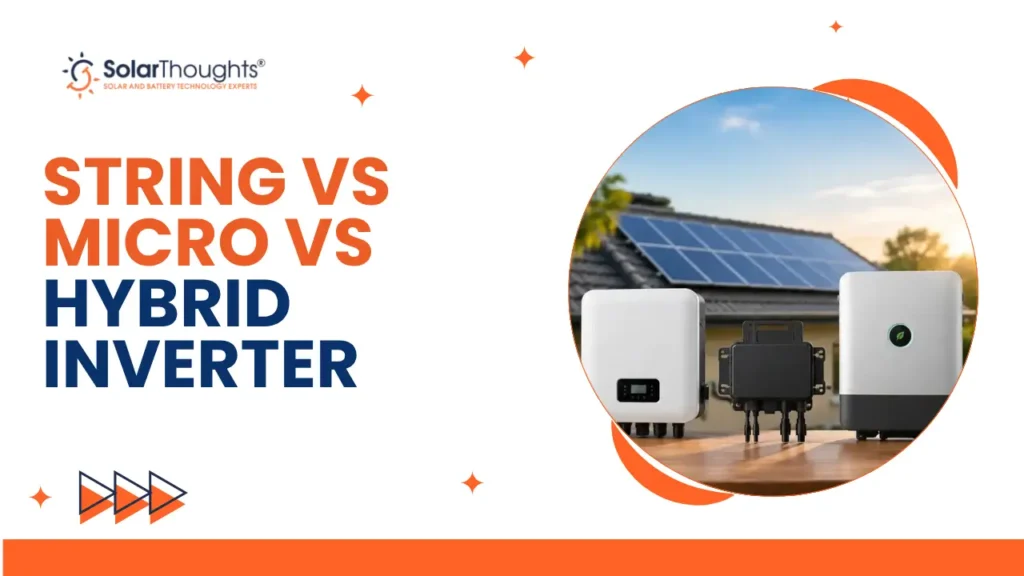
There are three main types of solar inverters: string inverters, microinverters, and hybrid inverters. A string inverter connects a row of panels to one central unit, a microinverter sits under each individual panel, and a hybrid inverter manages both solar and battery storage in one device.
Each solves a different problem. String inverters keep costs down on straightforward roofs. Microinverters handle shade and complex layouts by letting every panel work on its own. Hybrid inverters prepare your system for a battery without a second upgrade down the track.
The right choice depends on your roof, your budget, and whether you plan to store energy. Let’s look at each in turn, then compare them side by side.
What Is a String Inverter, and Who Is It Best For?
A string inverter is a single wall-mounted unit that converts the power from a whole “string” of panels wired together. It’s the most common and most affordable inverter type in Australia, which is why most standard systems use one.
The trade-off is how it handles shade. Because the panels are linked in a series, the weakest panel sets the pace for the whole string, so shade or dirt on one panel drags down the rest. That makes a string inverter the ideal choice for a simple, unshaded roof that faces mostly one direction.
String inverters are proven, easy to service from the ground, and typically last 10 to 15 years, so most homeowners will replace one during the life of their panels. If a fault appears, our guide on why your solar system isn’t reaching its peak power helps you diagnose it.
What Is a Microinverter, and Who Is It Best For?
A microinverter is a small unit installed under each individual panel, so every panel converts its own power and works independently of the others. Brands like Enphase are the best known in this category.
This design is the answer to shade and complex roofs. If one panel is shaded by a tree, a chimney, or a neighbouring building, only that panel’s output drops while the rest keep performing. That makes microinverters a strong fit for homes with panels across several roof faces, or roofs broken up by obstructions. Our guide on shade-proof solar panels pairs well with this.
Microinverters also run at safer low DC voltages and tend to last longer, often carrying warranties up to 20 to 25 years. The catch is cost, since fitting a unit to every panel raises the upfront price compared with a single string inverter. Panel-level monitoring is a bonus, letting you see the performance of each panel rather than the system as a whole.
What Is a Hybrid Inverter, and Who Is It Best For?
A hybrid inverter manages both solar generation and battery storage in a single unit. It does the normal job of converting solar power, but it also controls charging and discharging a battery, which a standard string inverter cannot do on its own.
This makes it the natural choice if a battery is part of your plan, now or later. Fitting a hybrid inverter up front means you can add storage without replacing your inverter, saving a second round of cost and labour. Popular models like the Fronius GEN24 are built exactly for this, and our guides on the Fronius GEN24 for blackout prep and battery charging and DC-coupled vs AC-coupled go deeper.
Because so many Queensland homeowners are adding batteries in 2026 to beat low feed-in tariffs, hybrid inverters have become a popular default even for people who won’t install storage straight away. If you’re weighing a battery, our guide on adding a battery to an existing solar system is worth a read.
String vs Micro vs Hybrid: How Do They Compare?
The table below sums up the practical differences that matter when you’re choosing. Use it as a quick reference against your own roof and plans.
| Feature | String inverter | Microinverter | Hybrid inverter |
|---|---|---|---|
| How it works | One unit for a string of panels | One unit per panel | One unit for solar plus battery |
| Best roof | Simple, unshaded, one direction | Shaded or multi-angle | Any, when a battery is planned |
| Shade handling | Weakest panel limits the string | Each panel independent | Same as string, unless paired with optimisers |
| Battery ready | No, needs extra gear | Needs AC-coupled battery | Yes, built in |
| Typical lifespan | 10 to 15 years | 20 to 25 years | 10 to 15 years |
| Upfront cost | Lowest | Highest | Middle to high |
| Panel-level monitoring | No | Yes | No |
Which Solar Inverter Is Right for Your Home?
The best inverter comes down to your roof, your budget, and your battery plans. Match your situation to the options below for a quick steer before you get a professional design.
- Simple roof, tight budget, no battery planned: a string inverter gives you proven performance at the lowest cost.
- Shaded roof or panels on several faces: microinverters stop one bad panel dragging the rest down.
- Battery now or within a few years: a hybrid inverter saves you a second upgrade and is the most future-proof.
- Want to see each panel’s output: microinverters give panel-level monitoring that string and hybrid units don’t.
- Large system needing full export: check your supply too, since big systems may need three-phase power. Our guide on single phase vs three phase explains when that applies.
There’s no single winner, only the right fit for your home. A good installer will model your roof and your goals rather than default to one type, which is exactly what our solar inverter installation team does.
How Much Do the Different Inverters Cost?
Cost is where the three types separate most clearly. A string inverter is the most affordable, which is a big reason it remains the default on standard systems. A microinverter system costs the most because you’re buying a unit for every panel. A hybrid inverter sits in the middle to upper range, since it does the work of a string inverter plus battery management.
As a rough guide for a typical home in 2026, a string inverter replacement runs around $1,000 to $2,500 installed, a hybrid inverter around $2,000 to $4,000, and a full microinverter system around $2,000 to $3,500 or more depending on panel count. These figures move with system size, brand, and install complexity, so treat them as a starting point rather than a quote.
It helps to weigh the upfront cost against the lifespan. A string inverter costs less now but will likely need replacing sooner, while microinverters cost more up front yet often outlast the first panel warranty. Our guide on how much solar panels cost in Brisbane puts inverter cost in the context of the whole system.
Does Your Inverter Choice Affect Adding a Battery Later?
Yes, and this is one of the most important points to get right. Your inverter type decides how easily you can add storage down the track, so it’s worth thinking about even if a battery feels far off.
A hybrid inverter is built for a battery, so adding one later is straightforward. With a standard string inverter, you’ll either add an AC-coupled battery that brings its own inverter, or replace the string inverter with a hybrid one, which is a bigger job. Microinverter systems also use AC-coupled batteries when the time comes. Our comparison of DC-coupled vs AC-coupled explains the difference and the cost impact.
Given how many Queensland homes are adding batteries to offset low feed-in tariffs, planning your inverter around future storage can save real money. If you’re close to deciding, our guide on choosing the right battery size is a useful next step.
Common Mistakes to Avoid
Choosing a string inverter for a shaded roof. One shaded panel drags down the whole string, so a shaded or complex roof usually wants microinverters.
Overpaying for microinverters on a simple roof. If your roof is unshaded and faces one way, a string inverter delivers similar output for less money.
Ignoring battery plans. Fitting a standard inverter when a battery is coming means paying twice. A hybrid inverter avoids the second upgrade.
Focusing only on upfront price. A cheaper inverter with a short warranty can cost more over its life than a pricier, longer-lasting unit.
Forgetting about monitoring. If you want to track each panel and catch faults early, only microinverters give panel-level data.
Frequently Asked Questions
What is the difference between a string, micro, and hybrid inverter? A string inverter serves a row of panels, a microinverter sits under each panel, and a hybrid inverter manages both solar and a battery in one unit.
Which solar inverter is best for a shaded roof? Microinverters, because each panel works independently, so shade on one panel doesn’t drag down the others.
Is a hybrid inverter worth it if I don’t have a battery yet? Often yes. Fitting a hybrid inverter now lets you add a battery later without replacing your inverter.
Are microinverters better than string inverters? They’re better for shaded or complex roofs and offer panel-level monitoring, but they cost more. String inverters win on price for simple roofs.
How long do solar inverters last? String and hybrid inverters typically last 10 to 15 years. Microinverters often last 20 to 25 years.
Which inverter is cheapest? String inverters have the lowest upfront cost, which is why they’re the most common choice on standard systems.
Can I add a battery to a string inverter? Yes, usually with an AC-coupled battery that has its own inverter, or by upgrading to a hybrid inverter.
Do microinverters produce more power? On shaded or multi-angle roofs they can, because each panel is optimised independently. On a simple roof the difference is small.
What inverter do I need for a large system? Any type can work, but large systems may need three-phase power to export fully, so check your supply early.
Is a hybrid inverter the same as a battery? No. A hybrid inverter manages a battery, but the battery is a separate component you buy and install alongside it.
Conclusion
Choosing between a string vs micro vs hybrid inverter comes down to three questions: how complex is your roof, what’s your budget, and is a battery in your future. A string inverter wins on price for simple roofs, microinverters handle shade and complex layouts, and a hybrid inverter future-proofs your system for storage.
There’s no universal best, only the right match for your home and plans. Get the inverter choice right and your system performs better, lasts longer, and adapts to a battery when you’re ready.
Not sure which inverter suits your roof? Contact SolarThoughts for a free system assessment and we’ll recommend the right inverter for your Brisbane home.