If you’re adding a battery to your solar system, you may have heard that your safety switches need to change. It’s one of the more confusing parts of a battery install, and it’s easy to be told either too much or too little about it.
Table of Contents
ToggleThis guide clears it up. You’ll learn what an RCD safety switch is, the different types, why Type AC devices can no longer be installed in Queensland, and what actually happens to your safety switches when you add a battery. The goal is to help you understand the rules, so you can ask your installer the right questions.
Do You Need a New Safety Switch for a Solar Battery?
Not automatically. Installing a solar battery does not mean every existing safety switch in your home must be replaced. What it does mean is that your licensed electrician must assess the circuits affected by the battery and make sure the protection on them is suitable and compliant.
Here’s the nuance that matters. Where new or replacement RCD protection is needed on affected circuits, it must be a compliant type, and Type AC can no longer be installed. Older Type AC devices on unrelated circuits don’t have to be ripped out just because you added a battery, but any device on an affected circuit has to be checked for suitability.
So the honest answer is “it depends on your circuits,” which is exactly why a proper assessment is part of a good battery quote. Our guide on adding a battery to an existing solar system covers the broader retrofit picture.
What Is an RCD, and How Is It Different From a Circuit Breaker?
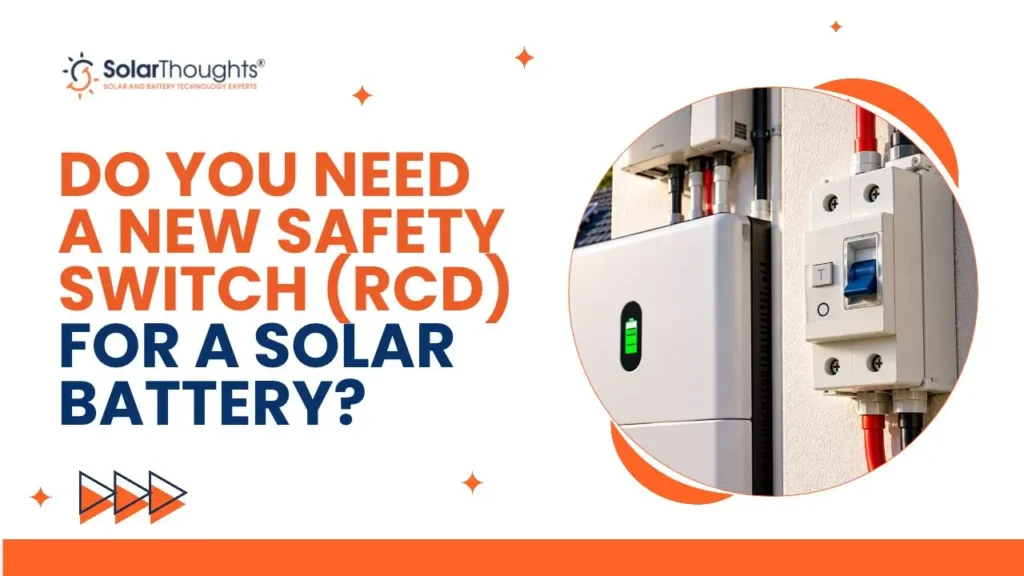
An RCD, or residual current device, is the safety switch that cuts power fast if it detects electricity leaking to earth, which protects you from electric shock. It’s not the same as a circuit breaker, which does a different job.
A conventional miniature circuit breaker, or MCB, protects against overcurrent, meaning too much current flowing, such as from a short circuit or overload. An RCD watches for leakage to earth instead. A combined device called an RCBO does both jobs in one unit. The important point is that the RCD “type” describes what kinds of electrical leakage it can detect, which is a separate thing from its current rating.
This distinction becomes important with batteries and inverters, because those devices can create forms of leakage that older safety switches weren’t designed to catch. Our guide on whether solar panels can cause fires covers related electrical safety.
What Are the Different RCD Types?
There are four main RCD types, labelled AC, A, F, and B, and the letter describes which waveforms of leakage current the device can detect. It is not the same as the current rating, such as 20A or 40A, or the sensitivity, such as 30mA.
The table below sums up the four types and what they mean in practice for Queensland homes. The right choice depends on the connected equipment and the inverter manufacturer’s instructions.
| RCD type | Detects | Practical significance in Queensland |
| Type AC | Sinusoidal AC leakage only | Cannot be newly installed since 30 April 2023. Generally unsuitable for inverter circuits. |
| Type A | AC plus pulsating DC leakage | Common for modern circuits, but not a universal fix for battery inverters or EV charging. |
| Type F | Type A plus certain mixed-frequency leakage | May suit particular inverter-driven appliances when required by their instructions. |
| Type B | Type F plus smooth DC leakage | May be required for certain inverters and power-electronic systems. |
As the table shows, the type letter is about capability, not size. That’s why you can’t tell an RCD’s type just from a “30mA” or “C16” marking, which describe sensitivity and trip curve, not the waveform type.
Why Are Type AC RCDs Banned for New Installs in Queensland?
Type AC RCDs cannot be newly installed in Queensland from 30 April 2023, because the wiring standard was updated to require devices that detect a wider range of leakage. The change comes from AS/NZS 3000:2018 Amendment 2, and Queensland applied it with no extra transition period.
The reason is modern electronics. Appliances, inverters, and chargers can produce pulsating or smooth DC leakage that a Type AC device is not designed to catch, which could leave a fault undetected. Newer types like Type A and Type B detect more of these waveforms, so they protect you better. You can read the Queensland Electrical Safety Office advice on the Type AC RCD installation prohibition.
It’s important to be clear about what the rule is. It’s a ban on installing new Type AC devices, not a blanket order to replace every Type AC device already in service. That distinction matters for your wallet, which we’ll cover next.
Do You Have to Replace Existing Type AC Safety Switches?
No. Queensland’s rule prohibits installing new Type AC RCDs, but it does not require you to replace every pre-existing Type AC device simply because you add a battery. Your existing safety switches on unrelated circuits can generally stay.
What your electrician must do is assess protection on any circuit that’s altered or newly supplied by the battery backup, and replace any device that isn’t suitable. So if adding a battery changes how a circuit is supplied, the safety switch on that circuit gets checked, and if it needs replacing, the new one cannot be Type AC. The Queensland ESO stresses checking safety-switch suitability when connecting fixed equipment like this.
This is why a battery install isn’t a fixed menu. The exact work depends on your switchboard, your circuits, and your backup configuration, which is covered in our guide on full versus partial home backup.
Is Type A Always Enough for a Battery?
No. Type A is a common and capable choice, but it is not automatically the right answer for every battery or inverter. It detects sinusoidal AC and pulsating DC leakage, but it is not designed to detect every form of smooth DC leakage.
Where the equipment’s leakage characteristics demand it, a Type B device or another expressly permitted arrangement may be necessary. The deciding factors are the inverter manufacturer’s instructions and the relevant Australian Standards, not a rule of thumb. In fact, the worst thing an installer can do is apply a blanket rule like “all batteries need Type A” or “all hybrid inverters need Type B.” The correct approach is to assess each location and confirm the right protection for the actual equipment, which our roundup of the best solar battery brands in Brisbane can help you shortlist.
What Happens to Your Safety Switches When You Install a Battery?
It depends on whether your battery is grid-connected only or includes backup, because backup changes how circuits are supplied during an outage. Either way, a licensed electrical contractor assesses the protection involved.
For a grid-connected battery without blackout backup, the electrician checks the inverter connection, whether RCD protection is required, and whether any RCD used suits the leakage waveform and the manufacturer’s requirements. The battery alone doesn’t mean every unrelated household safety switch must change.
For a battery with essential-load or whole-home backup, there’s more to assess, because nominated circuits are supplied differently during a grid outage. The electrician must check all affected circuits and their protection in both grid and backup modes, and existing Type AC devices on those circuits cannot simply be assumed compatible with the inverter supply. Our guide on using solar during a power outage and our smart solar battery backup overview explain how backup changes your setup.
Want a battery installed to Queensland standards without the guesswork? Talk to SolarThoughts about a compliant battery install and we’ll assess your switchboard properly.
How Do You Know Your Battery Install Is Compliant?
You know your install is compliant when a licensed electrical contractor has assessed the circuits, fitted suitable protection, and tested and documented the work. Compliance isn’t a single part, it’s the whole process done correctly.
A sound Queensland battery install generally covers these points:
- Identify existing RCD types and circuit assignments before quoting.
- Confirm the backup type, whether grid-connected only, essential-load, or whole-home backup.
- Check the inverter and gateway instructions for residual-current protection requirements.
- Never install Type AC RCDs as part of new electrical work.
- Assess existing RCDs on all affected backup-supplied circuits, and upgrade where necessary.
- Verify earthing, isolation, and fault protection for both grid and backup modes, then test and commission.
If you’re also upgrading an older board to handle a battery, our guide on switchboard and meter box upgrades explains when that’s needed. The detail always comes down to your specific inverter, switchboard, and circuits, which is why this is work for a licensed professional.
Common Mistakes to Avoid
Assuming you must replace every safety switch. The ban is on installing new Type AC devices, not on keeping compliant existing ones on unaffected circuits.
Applying a blanket RCD rule. “All batteries need Type A” or “all inverters need Type B” is wrong. The right type depends on the actual equipment and instructions.
Reading the type off the trip rating. A “30mA” or “C16” marking tells you sensitivity and trip curve, not whether a device is Type AC, A, F, or B.
Skipping the circuit assessment. With backup, circuits are supplied differently in an outage, so protection must be checked in both modes.
Using an unlicensed installer. RCD selection, wiring, and commissioning must be done by a licensed Queensland electrical contractor.
Frequently Asked Questions
Not automatically. Your electrician assesses the affected circuits, and fits a compliant RCD where new or replacement protection is needed.
They cannot be newly installed since 30 April 2023, under AS/NZS 3000:2018 Amendment 2. Existing ones aren’t automatically banned.
Not solely because you add a battery. Only devices on altered or backup-supplied circuits that aren’t suitable must be replaced.
Type AC detects AC leakage only. Type A also detects pulsating DC leakage, which makes it more suitable for modern circuits.
No. Type A doesn’t detect every form of smooth DC leakage. Some inverters need Type B, depending on the manufacturer’s instructions.
A residual current device, or safety switch, that cuts power quickly if it detects electricity leaking to earth, protecting you from shock.
No. A circuit breaker protects against overcurrent. An RCD protects against earth leakage. An RCBO combines both.
Check the device marking or datasheet, not the trip rating. A “30mA” or “C16” label doesn’t identify the waveform type.
Yes. Backup supplies circuits differently in an outage, so protection must be assessed and verified in both grid and backup modes.
A licensed Queensland electrical contractor, based on your inverter’s instructions, the circuits, and the relevant Australian Standards.
Conclusion
The short version is reassuring: adding a solar battery does not mean replacing every safety switch in your home. What it does mean is that a licensed electrician assesses the circuits your battery affects and fits suitable, compliant protection where it’s needed, and that any new RCD cannot be a Type AC device.
The right RCD type depends on your inverter and circuits, not a blanket rule, which is exactly why a proper assessment belongs in your battery quote. Get that right, with a licensed Queensland contractor, and your battery is both safe and compliant.
Planning a battery and want it done to standard? Contact SolarThoughts for a compliant battery assessment and quote and we’ll check your switchboard before we install.
This article is general guidance only. Final compliance decisions and electrical work must be carried out by a suitably licensed Queensland electrical contractor, in line with the Electrical Safety Act 2002, the Electrical Safety Regulation 2026, applicable Australian Standards, and manufacturer instructions.