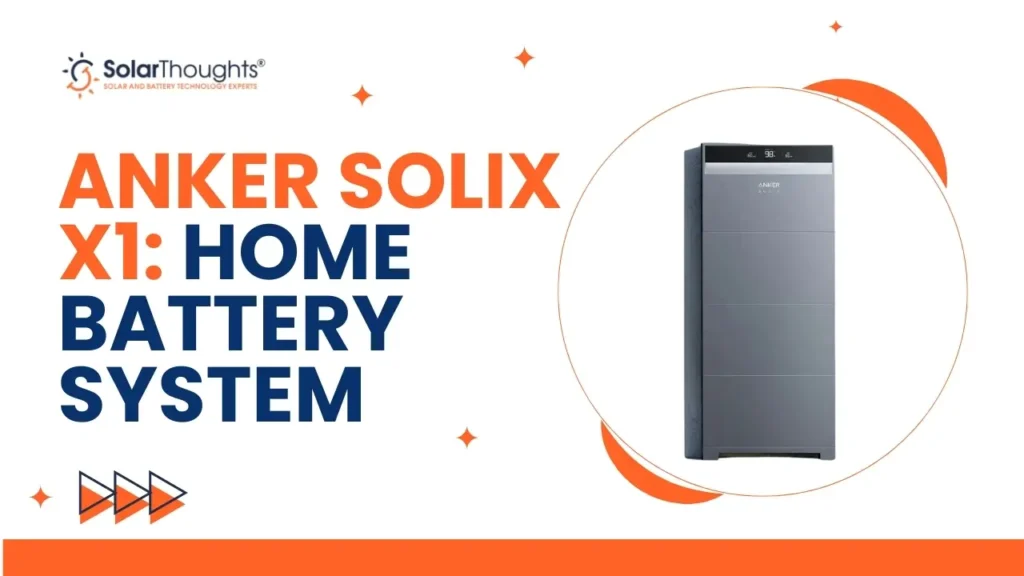
Choosing the right home battery system is a big decision. Many homeowners look for reliable power, smart features, and a good investment. The Anker SOLIX X1 is a new option in the Australian market. It combines a hybrid inverter with a stackable battery. This system promises to help you use more of your solar power. At SolarThoughts®, we recently completed our first installation of the SOLIX X1 in the Brisbane region: a 6 kW single-phase hybrid inverter with a 20 kWh battery stack. We looked at every detail — how easy it was to install, its features, and how well it performs. Here is our honest review, based on real-world experience.
Table of Contents
ToggleWho is Anker?
Anker is a company with a strong history in consumer electronics. They started in 2011 and are well-known globally. They have extended into the Australian solar home battery market in recent years. Many people know Anker for:
- Home security cameras (the “Eufy” range)
- Phone and laptop accessories: chargers, cables, adapters
- Rugged portable batteries for camping and mobile use
- 3D printers and other tech gadgets
This background gives confidence as they move into the home energy market.
Installing the Anker SOLIX X1 System
We found the Anker SOLIX X1 battery straightforward to install. The system was assembled quickly, and the user manual was clear. However, we noted a few minor issues:
- Adjustable bases: Newer models include adjustable bases — this matters for uneven ground. In our case, we poured a concrete slab to get the battery level.
- Wall brackets: The wall bracket stops tipping, but doesn’t bear all the weight. The system shipped with one plastic shim; for a tall 20 kWh stack, we added wedges to eliminate rattling.
- Template alignment: The mounting template was slightly off — installers just need to check alignment carefully.
Despite these small points, overall installation was smooth.
Design, Build Quality & User Features
The Anker SOLIX X1 stands out for its design:
- Coastal and corrosion-resistant: “C5-M” marine rating, meaning it’s suitable for installations near the coast (ideal for Gold Coast / Sunshine Coast homes).
- Slim profile: At ~150 mm width, it sits nicely on a wall in a garage or utility room without intrusion.
- Stackable battery modules: The base unit + 5 kWh modules allow 20 kWh or more in a compact stack.
- Built-in screen: Unlike many systems that rely only on apps, the SOLIX X1 features a clear display showing solar production, battery charge %, and house usage — a hit among our QLD customers.
Inverter Performance & Efficiency
The SOLIX X1 is a hybrid inverter system when bundled, though as one review states, it’s “good, but likely not as good as the premium brands when tested side-by-side”.
Key performance notes:
- The system we installed showed an overall efficiency of around ~90.5% in real usage (according to our monitoring) — this is slightly below some competitor systems that claim ~95%.
- We noticed the right-hand side of the battery stack ran warm during charging; we attribute this to the DC-to-DC converters (“optimisers”) inside the system.
- The hybrid inverter’s MPPT / shade-handling capability is adequate, but the two-MPPT config may limit design flexibility for some roof arrays.
Battery Features & Backup Power
With 5 kWh modules stacked (we used four = 20 kWh), the SOLIX X1 offers strong backup potential. Features we tested:
- EPS (Emergency Power Supply) / islanding contactors — the system supported backup circuits and passed a blackout simulation with no flicker.
- Seamless transition to backup mode — from mains off to battery on, in our test, it was smooth and fast.
- Missing feature: The system currently does not send push-notifications when it switches to backup (blackout) mode, so the homeowner may not realise. We hope Anker adds this in the future.
Battery Architecture: Optimisers & Longevity
Anker’s architecture uses modular 5 kWh units with DC-to-DC converters (called “optimisers”) inside. Pros & cons:
Pros:
- Modular design allows expansion and individual module replacement.
- Flexibility in installation layout (MC4 connectors, side-by-side modules).
Cons: - More components (optimisers, converters) mean more potential failure points.
- Heat generation was noted during charging — heating stresses components, possibly reducing lifespan over time.
Configurability & Flexibility
We found good flexibility: you can start with a smaller stack and add modules later. The physical layout options (wall-mount modules side-by-side) suit many garage/utility spaces common in Brisbane/Coast homes.
The App & Installer Tools
The Anker app is a highlight: clean UI, easy monitoring of production vs consumption vs battery. The time-of-use (TOU) tariff setup is straightforward. That said:
- Installer/diagnostic tools are still developing; some detailed metrics (e.g., live module voltages/currents) are not yet exposed.
- For large system diagnostics, installer feedback suggests that more remote data access would be beneficial.
Warranty Details for Peace of Mind
Warranty summary (Australia):
- 10-year warranty on inverter and battery modules.
- Residual capacity guarantee: approx 60 % after 10 years (some reviews say 60 % vs industry ~70 %).
- Throughput limit: around ~3.29 MWh per kWh of capacity (for example, modules) according to an independent review.
Overall, the warranty is solid — but there are some trade-offs compared to market leaders.
Would We Recommend the Anker SOLIX X1?
Yes — but with conditions. For many Queensland homes, it is a strong option.
Why we would recommend it:
- Good build, sleek design, modular capacity, strong brand backing (Anker).
- Ideal for homes with existing solar looking for a battery upgrade, or newer homes aiming for flexibility.
- Excellent for coastal/Gold Coast / Sunshine Coast installations, given its corrosion rating and design.
Why we would exercise caution / consider alternatives: - If you have very high power demands (large three-phase system, EV + pool + heavy loads), you may want an inverter with more MPPTs or premium efficiency.
- If you plan heavy cycling/extreme longevity, the slightly lower residual capacity and extra component complexity (optimisers) are factors.
- If you need ultra-tight diagnostics/tools now, premium brands have deeper installer ecosystems.
In summary, the Anker SOLIX X1 is a compelling option for many homes in the Brisbane / Gold Coast / Sunshine Coast region. At SolarThoughts®, we’re comfortable specifying it, particularly where its strength (modularity, design, flexibility) matches the home’s profile. But as always, match the system to the home’s usage, installation conditions, budget, and plans.
Of course, a battery like the SOLIX X1 only performs as well as the solar array feeding it. If you’re planning a new install or upgrading an existing system to make the most of your storage, you can browse our range of tier-1 solar panels from trusted brands like Canadian Solar, JA Solar, Jinko, and Risen, all chosen to suit Queensland conditions and maximise the energy your battery stores each day.
Our Popular Services
New Solar Panel Installation | Upgrade Solar Panel System | Battery Storage Installation | Ev Charger Installation | Inverter Installation in Brisbane