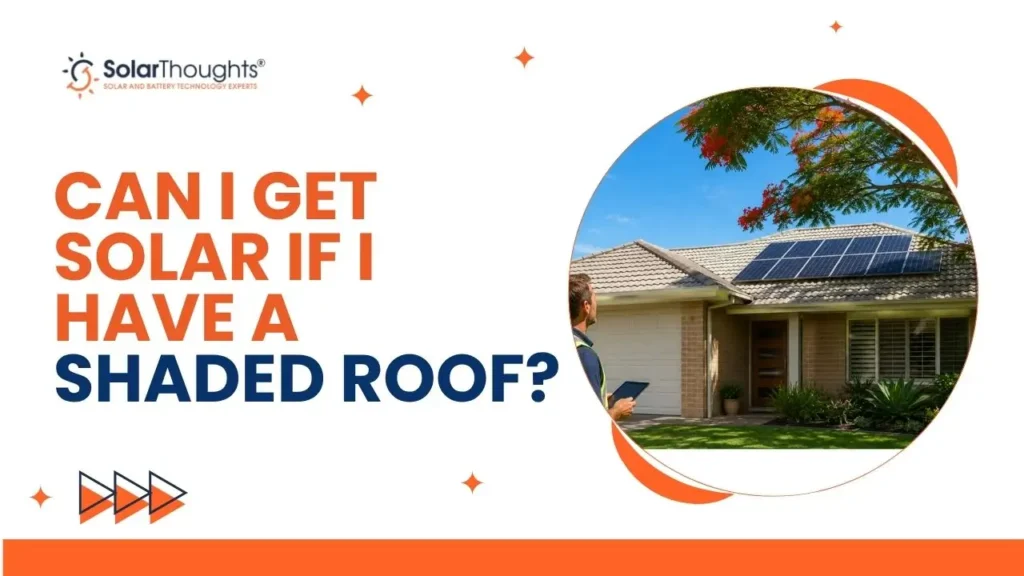
You have been thinking about solar for a while. Every time you look up at your roof, you see a tree casting a shadow across the tiles, or a neighbour’s extension blocking the morning sun. And the question keeps coming up: is solar actually worth it for a roof like mine?
Table of Contents
ToggleHere is the honest answer. A shaded roof in Brisbane does not automatically rule out solar panels. Modern technology has changed what is possible. With the right system design, most Brisbane homeowners with partial shading can still generate meaningful electricity savings. But there is a threshold below which the numbers stop working, and a trustworthy installer will tell you where your roof sits before you spend anything.
This guide explains how shading affects solar output, what technologies solve the problem, and how to know whether your roof qualifies.
How Does Shading Actually Affect Solar Panels?
Quick Answer: In a standard string inverter system, all panels are linked together in a series circuit. When one panel is shaded and produces less power, the output of the entire string drops to match it. This is why shade on even one or two panels can drag down a whole rooftop system, not just the panels actually in shadow.
Solar panels generate electricity by converting sunlight into direct current through photovoltaic cells. In a traditional string inverter system, panels are wired in series and their combined output is converted to AC power by a single central inverter. The system can only perform as well as its weakest link. One shaded panel throttles the rest of the string.
A 2023 peer-reviewed study published in Solar RRL (Allenspach et al.) found that under real rooftop obstruction shading, string inverter systems lost 24% of annual yield compared to only 9% for systems fitted with DC power optimisers. That 15 percentage point recovery represents a significant real-world difference on any Brisbane system.
The impact of shading also depends heavily on the type and timing of the shadow. A chimney that casts a small shadow across one panel for 90 minutes each morning is a very different situation from a large Poinciana tree blocking three-quarters of your north-facing roof all day. A qualified installer evaluates both when designing a system.
What Technologies Fix the Shading Problem?
There are three main hardware solutions for shaded roofs in Brisbane. Each suits a different shading profile and budget.
Microinverters
A microinverter is a small inverter mounted directly behind each individual solar panel. Instead of converting power from all panels together at one central unit, every panel handles its own DC-to-AC conversion independently. A shaded panel underperforms on its own without pulling any other panel down with it.
Microinverters also provide panel-level monitoring, meaning you can see the exact output of every panel in real time through a smartphone app. This matters for detecting problems early, before they silently cost you months of lost generation. The Enphase IQ8 is the most widely deployed microinverter brand across Brisbane and South East Queensland and is installed by SolarThoughts® on systems where shading is a concern.
The tradeoff is the upfront cost. Microinverters add to the system price compared to a standard string inverter setup. For heavily shaded roofs, the additional yield over the system’s lifetime typically justifies that investment. Peer-reviewed research confirms that module-level power electronics recover their cost premium within one to three years on roofs with moderate to heavy shading.
DC Power Optimisers
DC optimisers attach to the back of each panel and condition the panel’s power output before sending it to a central string inverter. Unlike microinverters, there is still one central inverter on the wall. The optimisers ensure that a shaded panel only affects its own output, not the others.
SolarEdge is the most widely used DC optimiser brand in the Australian residential market. Optimisers deliver similar shade-recovery performance to microinverters in most real-world scenarios and include panel-level monitoring. They typically represent a lower cost premium than a full microinverter array, making them a strong option for roofs with moderate rather than severe shading.
Bypass Diodes (Built Into Your Panels)
Every modern solar panel includes bypass diodes as a built-in shade response. When part of a panel is shaded, the diode routes current around the affected cell cluster so the rest of the panel keeps producing. Standard residential panels have three internal bypass diodes, meaning partial shading does not necessarily shut down the whole panel.
Bypass diodes work passively at no extra cost. They are most effective for mild, temporary shading such as a bird sitting on a panel or a thin cable. For regular, significant shading from trees or neighbouring buildings, bypass diodes alone are not sufficient and need to be paired with microinverters or DC optimisers to protect overall system performance.
How Roof Orientation Interacts With Shade in Brisbane
Brisbane sits at approximately 27 degrees south latitude. North-facing panels receive the most consistent direct sunlight across all seasons. According to the Clean Energy Regulator’s solar zone data, Brisbane falls in STC Zone 2, which reflects the region’s strong solar resource. The city averages 5.2 peak sun hours per day, making it one of the best locations in Australia for rooftop solar.
Here is how each roof face performs for a typical Brisbane system on a well-designed installation:
| Roof Face | Approx. Daily Output (6.6kW) | Best For |
| North-facing | 26 to 29 kWh/day | Best for maximum annual generation |
| East-facing | 21 to 24 kWh/day | Good for morning self-consumption households |
| West-facing | 22 to 25 kWh/day | Good for afternoon peak users |
| North-East split | 24 to 27 kWh/day | Balanced output across the day |
| South-facing | 15 to 18 kWh/day | Generally not recommended |
Output ranges are indicative based on Brisbane’s 5.2 peak sun hours and standard installation conditions. Source: Clean Energy Regulator solar zone data.
The key strategic insight for shaded roofs: splitting panels across two roof faces using microinverters or DC optimisers can outperform a north-only array that is heavily shaded. A well-designed east-west split where each panel operates independently often delivers stronger overall output than forcing everything onto a partially shaded north face.
At SolarThoughts®, every site assessment includes solar modelling that tests multiple panel placement configurations to find the design that delivers the best real output for your specific roof.
How a Professional Shade Assessment Works
The most important thing to understand about assessing a shaded roof: a visual check from the ground tells you almost nothing useful. Shade is a time-dependent, seasonal problem. A tree that casts a small shadow at 9am may block half the roof by noon in winter, then barely touch it in summer. You need time-resolved data across all seasons.
Professional installers in Brisbane use aerial imagery tools, sun-path simulation software, and physical assessment instruments to map shade across every hour of every day of the year. This produces a solar access score, expressed as a percentage of how much theoretically available sunlight actually reaches each roof section after accounting for all obstructions.
Here is what the solar access score thresholds mean in practice:
• Above 80%: A well-designed string inverter system with quality panels is appropriate.
• 60 to 80%: DC optimisers or microinverters are strongly recommended to recover shading losses.
• Below 60%: The financial viability of rooftop solar needs careful evaluation. Some roof sections may need to be excluded from the layout entirely.
Want to know your roof’s solar access score? Book a free solar panel installation assessment in Brisbane with SolarThoughts®. Our team uses sun-path modelling to show you the expected output for your specific roof before you commit. Call 1300 846 844.
When Is a Shaded Roof Too Shaded for Solar?
Not every shaded roof makes financial sense for solar, and a trustworthy installer will tell you that rather than proceed with a system that will disappoint.
The clearest warning signs that shading may be too severe:
• Permanent, dense shade for most of the day from large established trees or neighbouring buildings that cannot be trimmed or removed.
• A solar access score below 50 to 60% across all usable roof sections after a full shade analysis.
• Only south-facing roof sections available, where Brisbane’s sun angle means output is too low regardless of shading technology.
If your north-facing roof is badly shaded, it is worth checking whether your east or west-facing sections have better solar access. In many Brisbane homes, particularly in older inner suburbs with large established trees, a split-face design using module-level power electronics actually delivers better output than a shaded north-only array.
It is also worth noting that Brisbane’s 5.2 peak sun hours per day create a meaningful buffer compared to southern states. A system generating at 75 to 80% capacity in Brisbane can still produce more annual electricity than the same system running at full capacity in Melbourne or Adelaide. The sunshine advantage partially offsets the shading penalty, which is why partial shading in Brisbane is rarely the absolute dealbreaker it might be elsewhere.
Common Mistakes Brisbane Homeowners Make With Shaded Roofs
Ruling out solar based on a verbal ‘too shaded’ opinion without a formal shade analysis.
This was often valid when string inverters dominated every system. With microinverters and DC optimisers now standard, that old rule of thumb is outdated. Always request a sun-path analysis before accepting a no.
Installing a standard string inverter on a shaded roof to save money upfront.
If your roof has known shading, a string inverter will underperform significantly from day one. The additional investment in optimisers or microinverters is typically recovered through higher generation within a few years.
Mixing east-facing and west-facing panels on the same inverter string.
These two faces peak at different times of day. Placing them on a single string means neither performs well. A split east-west design always requires module-level power electronics with each face on its own independent MPPT channel.
Skipping tree trimming as a free first step.
Before committing to more expensive shade-mitigation hardware, ask whether trimming one or two branches would meaningfully reduce your worst shading. This is often the fastest and cheapest improvement available.
Not setting up panel-level monitoring after installation.
Microinverters and DC optimisers include monitoring capability as standard. If you do not configure the app, you have no way to detect if one panel degrades or stops performing. Set it up on installation day.
Assuming Brisbane’s sunshine compensates for any level of shading.
Brisbane’s 5.2 peak sun hours per day help a system running at 80% capacity. They do not rescue one running at 40%. A professional shade analysis is the only way to know which side of that line your roof sits on.
Frequently Asked Questions
Can solar panels work with partial shade in Brisbane?
Yes. With microinverters or DC optimisers, each panel operates independently so a shaded panel does not reduce the output of unshaded ones in the same system.
How much does shade reduce solar panel output?
Peer-reviewed research (Allenspach et al., Solar RRL 2023) found string inverter systems lost 24% of annual yield under real rooftop shading, compared to only 9% for systems with DC optimisers. Microinverters produce similar recovery on most residential rooftops.
What is the best solar inverter for a shaded roof in Brisbane?
Enphase IQ8 microinverters or SolarEdge DC optimiser systems are the two most recommended options for shaded roofs in Brisbane. Your installer will advise which suits your specific shading pattern and budget.
Does solar work on a south-facing roof in Brisbane?
South-facing roofs receive the least sunlight in the Southern Hemisphere and are generally not recommended. East or west-facing roofs are usually a better alternative if the north face is unavailable or heavily shaded.
What is a solar access score?
A solar access score is the percentage of available sunlight that actually reaches a given roof section after accounting for all shading. Above 80% suits string inverters. Between 60 and 80% warrants optimisers or microinverters. Below 60% requires careful financial evaluation.
Can trimming trees improve my solar output?
Yes. Removing or trimming shading trees is often the most cost-effective first step before investing in additional shade-mitigation technology.
Do microinverters cost more than standard string inverters?
Yes. Microinverter systems carry a higher upfront cost than standard string inverter setups. On regularly shaded roofs, the additional generation over the system’s lifetime typically recovers this difference.
Will shading void my solar panel warranty?
No. Shading does not affect solar panel product warranties. Improper installation, DIY modifications, or the use of non-approved cleaning products can.
Can I add a battery to a shaded solar system?
Yes. A battery stores the power your shaded system generates during the day for use at night, increasing self-consumption regardless of shading. Learn more about solar battery installation for Brisbane homes at SolarThoughts®.
How long does a shade assessment take?
A professional on-site shade assessment typically takes 30 to 60 minutes. SolarThoughts® includes this as part of our free solar site inspection in Brisbane.
Conclusion
A shaded roof in Brisbane does not mean solar is off the table. Modern microinverters, DC optimisers, and high-efficiency N-Type panels have made partial shading a manageable design challenge that skilled installers solve every day. Brisbane’s strong solar resource, averaging 5.2 peak sun hours per day according to Clean Energy Regulator data, means that even a partially shaded system here can still deliver strong long-term savings.
What shading does require is a more careful design process. The right technology, the right panel placement, and an honest assessment of your solar access score are what separate a system you will be satisfied with for 25 years from one that quietly underperforms from day one.
If you have a shaded roof in Brisbane, Gold Coast, Ipswich, or the Sunshine Coast, the most useful first step is a professional shade analysis from a CEC-accredited installer.
Book your free solar panel installation assessment with the SolarThoughts® team today. You can also explore our residential solar panel installation service and solar inverter options for Brisbane homes to understand what a shaded-roof system looks like in practice. Call 1300 846 844.
Sources
• Clean Energy Regulator, Solar Zone Maps (Australian Government)
• Allenspach et al., Solar RRL (2023) — DC optimiser shading loss study