It’s a grey Tuesday morning in Indooroopilly. The sky’s been overcast since dawn, your coffee’s gone cold, and the kids are arguing about Minecraft. You glance at your inverter app and see today’s solar output is sitting at maybe a third of yesterday’s.
Table of Contents
ToggleSo you ask the question almost every Brisbane solar buyer asks at some point: do solar panels work on cloudy days? And if they do, are they actually producing enough to be worth it during SEQ’s wet season?
Short answer: yes, they work, and yes, it’s still worth it. But the honest answer needs a bit more detail than the “10 to 25% output” line you’ll see copy-pasted across most blogs. This guide gives you real Brisbane numbers, an honest take from local installers, and a practical answer to whether SEQ’s cloudy days actually affect your payback.
Do Solar Panels Work on Cloudy Days
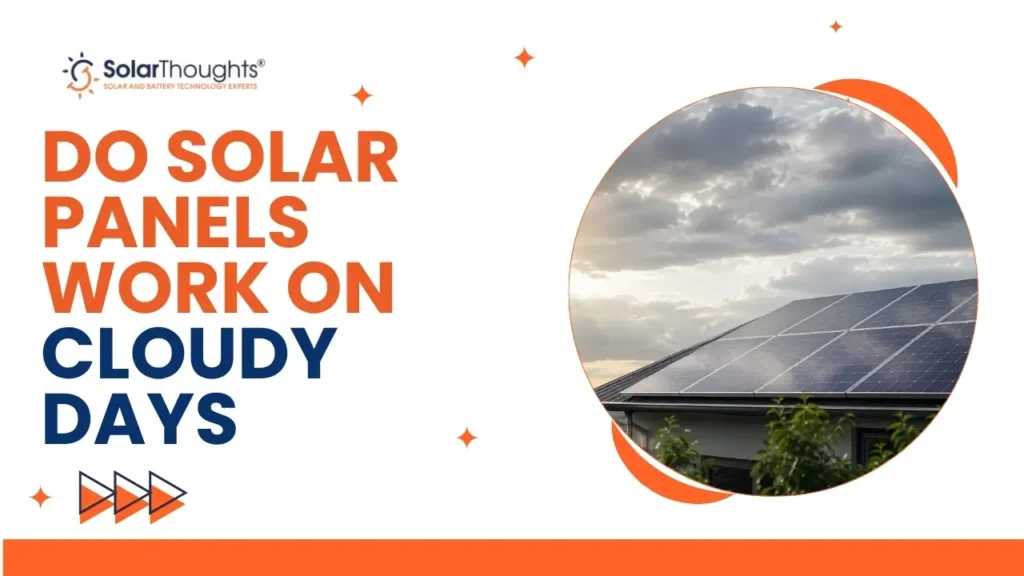
Yes, solar panels work on cloudy days. Output drops to roughly 70 to 90% of normal under light cloud, 25 to 60% under partial overcast, and 10 to 25% under thick storm cloud. Brisbane’s overall solar payback is barely affected because SEQ averages over 240 clear or partly cloudy days a year — far more than most of Australia.
That’s the answer most homeowners need. But the reason this question matters isn’t really about how panels handle one cloudy day — it’s about whether you’ll actually save money given Brisbane’s wet season, summer storms, and reputation for occasional weeks of grey weather. Let’s get into the real numbers.
The “10 to 25%” figure you’ll see quoted across most online articles comes from a single conservative US estimate based on heavy low-level overcast. In Australian conditions, real monitoring data tells a more nuanced story — and it’s better news than the lazy figure suggests.
How Solar Panels Actually Work in Low Light
To understand cloudy-day output, you need to know one thing: solar panels run on light, not heat. Specifically, they run on photons hitting silicon cells and dislodging electrons — the photovoltaic effect. Direct sunlight is not the only kind of light that does this.
There are two types of sunlight that reach your panels:
Direct irradiance — unobstructed beams from the sun on a clear day. This is what panels prefer, and what their rated output is measured against.
Diffuse irradiance — sunlight that’s been scattered through clouds, dust, or haze before reaching your roof. Less intense, but still energetic enough to generate electricity.
Your panels can’t tell the difference between the two — they convert any light that lands on them. That’s why a thick cloud doesn’t switch your system off. It just reduces how many photons make it through.
Here’s a practical test for Brisbane homeowners: if you can read a book without turning a light on, your panels are producing power. If you can see your shadow at all, even faintly, you’re generating somewhere between 30 and 70% of clear-sky output. The system never goes to zero during daylight hours unless you’re under a blackout-thick storm cloud — and even then, output usually sits around 10 to 15% of rated capacity, not zero.
Real Brisbane Output Numbers by Cloud Type
Here’s what a typical 6.6kW Brisbane system actually produces in different conditions, based on real monitoring data from rooftops across SEQ:
| Sky condition | Output % of rated | 6.6kW system daily kWh | Real-world Brisbane example |
| Clear summer day | 90 – 100% | 28 – 34 kWh | Cloudless November afternoon |
| Light scattered cloud | 70 – 90% | 22 – 28 kWh | Typical Brisbane spring day |
| Partial overcast | 40 – 70% | 12 – 22 kWh | Grey winter morning |
| Heavy storm cloud | 10 – 25% | 3 – 8 kWh | Summer afternoon thunderstorm |
| Light fog | 40 – 60% | 12 – 18 kWh | Misty Mt Coot-tha morning |
These are real-world ranges from Australian inverter monitoring data, including a study by Solar Analytics that tracked rooftop systems across Brisbane, Sydney, Melbourne, and Adelaide. The takeaway is simple: your worst cloudy day in Brisbane is still producing 3 to 8 kWh — enough to run a fridge, lights, internet, and a load of washing.
There’s also a quirk most US articles skip: the edge-of-cloud effect. When clouds move quickly across the sky, their bright edges can briefly magnify sunlight, pushing your panels above 100% of rated output for short bursts. Brisbane gets a lot of these conditions during summer storm afternoons — you’ll see spikes on your monitoring app that look almost too good to be true. They’re real.
Why Brisbane Is One of the Best Cloudy-Day Solar Markets in Australia
If you live in Brisbane, the Gold Coast, or the Sunshine Coast and you’re worried about cloud cover affecting your investment, here’s some perspective.
Brisbane gets:
• Around 124 cloudy days per year (Bureau of Meteorology long-term average)
• 240+ clear or partly cloudy days per year
• 5.2 average peak sun hours per day across the year
• Some of the highest solar irradiance levels of any Australian capital
Compare that to Hobart (around 200 cloudy days) or Melbourne (around 175). Brisbane is genuinely one of the best places in Australia for solar — even in winter, Brisbane systems still deliver around 73% of average annual output, compared to Melbourne’s 50%.
There’s a counterintuitive bonus too. Brisbane’s subtropical heat is actually a bigger drag on panel efficiency than cloud cover. Solar panels start losing efficiency above 25°C surface temperature — and on a cloudless 38°C January afternoon, your panels can be sitting at 65°C plus. A cool overcast 28°C day can sometimes deliver better total daily output than a sweltering blue-sky one. The ideal angle and orientation for solar panels in Brisbane matters more than chasing perfect weather.
Does the Wet Season Change Whether Solar Is Worth It?
This is the question Brisbane buyers really mean when they ask about cloudy days. Honest answer: barely.
SEQ’s wet season runs roughly from November to March. During this period, you’ll see more cloudy days, more storms, and lower per-day output. But you’ll also see longer daylight hours and a more direct sun angle — so even cloudy summer days produce more energy than sunny winter ones.
A typical Brisbane 6.6kW system produces approximately:
• Spring (Sept–Nov): 28 to 32 kWh per day average
• Summer (Dec–Feb): 26 to 30 kWh per day (high heat + storm cloud)
• Autumn (Mar–May): 22 to 26 kWh per day
• Winter (Jun–Aug): 18 to 22 kWh per day
So winter is actually the lowest-output season, not summer storm season. The wet season’s cloud cost is partially offset by the long daylight hours and the cooling effect of overcast skies on panel temperature.
On the financial side: a 6.6kW Brisbane system saves the typical household around $1,600 to $2,200 a year. Even if you lost 30 cloudy days completely (you don’t — you still produce 10 to 25%), you’d be out maybe $130 to $180 a year. Spread across the system’s 25-year life, the total cost of cloudy days in Brisbane is almost negligible compared to the $40,000+ in lifetime electricity savings.
Panel Choice and System Design That Maximise Cloudy-Day Output
If cloudy-day performance is a priority for you, a few decisions during installation make a real difference.
1. Choose monocrystalline or PERC panels: Monocrystalline cells handle diffuse light better than older polycrystalline panels. PERC (passivated emitter and rear contact) cells add a reflective rear layer that captures light a normal panel would miss — they’re now standard on most quality residential brands.
2. Consider east-west splits, not just north: North-facing panels deliver maximum total kWh per year. But east-west splits give you a flatter, longer production curve across the day — which means higher output during patchy cloud conditions when the sun is moving in and out behind clouds.
3. Get a hybrid inverter and consider a battery: Batteries store sunny-day surplus to cover cloudy stretches. With Queensland feed-in tariffs sitting around 5 to 10 cents per kWh and grid power costing 30+ cents, a quality solar battery installation pays back faster in cloudy weather, not slower.
4. Don’t undersize. If you’re worried about output dips, the answer is more panels, not fewer. Going from 6.6kW to 10kW costs around 30% more but gives you 50% more capacity to ride through grey days.
5. Pick an installer who’ll model your actual SEQ conditions. Generic solar quotes use national averages. A Brisbane-specific design factors in our cloud cover, temperature derating, and east-west sun arc — and produces a more honest savings estimate.
Common Myths About Cloudy-Day Solar
We hear these from Brisbane homeowners every week. Let’s clear them up.
Myth 1: Solar panels stop working when it’s cloudy. False. They reduce output, but they keep producing power any time there’s daylight bright enough to see by.
Myth 2: Solar isn’t worth it in places with regular cloud cover. False. Germany has roughly half Brisbane’s solar irradiance and is one of the world’s largest residential solar markets. Brisbane’s cloud cover is actually a non-issue at scale.
Myth 3: Heat and sun maximise output. Half-true. Sun helps, but heat above 25°C reduces panel efficiency. Cool sunny days outperform hot sunny days by 5 to 15%.
Myth 4: You need a battery to survive cloudy days. False. Grid-tied systems pull from the grid automatically when cloudy-day output is low. Batteries are about energy independence and time-of-use savings, not cloud-day insurance.
Myth 5: Solar panels work better in summer. Half-true. They produce more total kWh in summer due to longer days, but Brisbane’s January heat actually reduces per-panel efficiency. Brisbane’s best output month for efficiency is often October.
Myth 6: A cloudy week will spike your power bill. Almost never. With a properly designed solar system from a Brisbane installer, a cloudy week typically reduces your output by maybe $20 to $40 — usually offset later in the same month by sunnier weeks.
Frequently Asked Questions
Do solar panels work on cloudy days?
Yes. Output drops to 10 to 90% of normal depending on cloud thickness. Brisbane’s average cloudy day still produces meaningful power.
How much electricity do solar panels produce on a cloudy day in Brisbane?
A 6.6kW system produces 3 to 28 kWh on a cloudy day, depending on cloud type. Most days fall in the 12 to 22 kWh range.
Do solar panels work in the rain?
Yes. Panels are waterproof and rain actually helps by washing dust off. Output drops with cloud cover, but rain itself isn’t the issue.
Do solar panels work in winter in Brisbane?
Yes, very well. Brisbane winter solar output is around 73% of average annual production — much higher than southern Australian cities.
What is the edge-of-cloud effect?
When clouds move quickly, their bright edges can briefly magnify sunlight and push panels above rated output. Common during Brisbane summer storms.
Are monocrystalline panels better for cloudy weather?
Yes. Monocrystalline and PERC cells perform 10 to 20% better in low-light conditions than older polycrystalline panels.
Do solar panels work in fog?
Yes, at around 40 to 60% of normal output. Fog scatters more light than clouds but lets enough through to keep panels producing.
Do I need a battery for cloudy days?
No. Grid-tied systems pull from the grid automatically. A battery is for energy independence and time-of-use savings, not cloud insurance.
Conclusion
So, do solar panels work on cloudy days? Yes — at reduced output, but reliably, and even Brisbane’s worst storm-cloud days still produce enough power to run essential household appliances. The bigger picture matters more than any single grey morning: with 240+ clear or partly cloudy days a year, 5.2 average peak sun hours, and one of Australia’s strongest solar irradiance profiles, Brisbane is genuinely one of the best places in the country for residential solar.
If you’re still on the fence, the honest answer isn’t “it depends on the weather.” It’s: a properly designed system from a Brisbane installer, sized for your actual usage, with quality panels and a hybrid-ready inverter, will save you thousands a year regardless of what the SEQ sky decides to do. Cloudy days are a footnote in your payback calculation, not a deal-breaker.
Ready to see what a Brisbane-designed solar system would actually produce on your roof? Get a free solar installation quote in Brisbane.