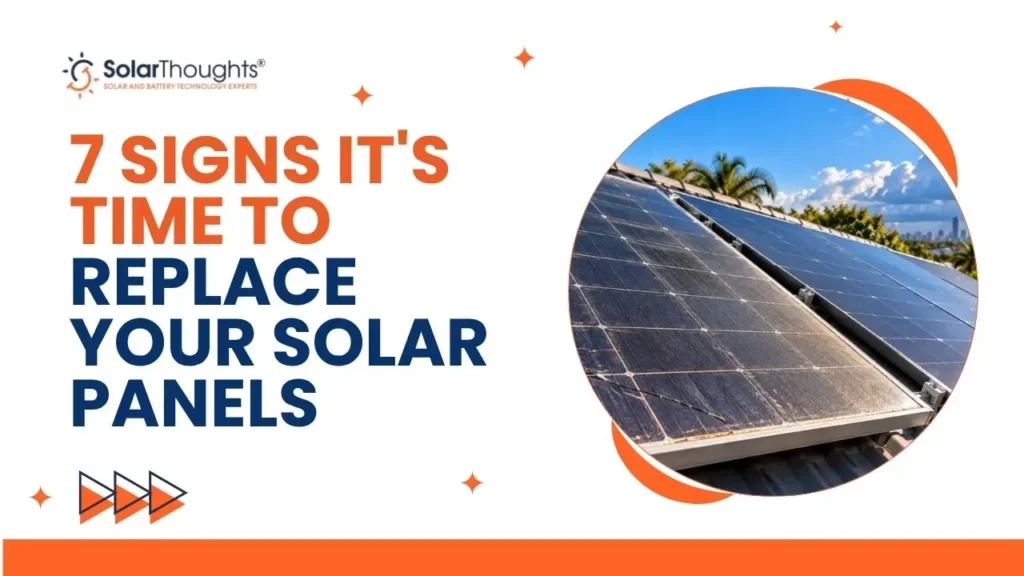
Most Brisbane homeowners don’t think much about their solar panels once they’re up on the roof. The system runs quietly, your bills come down and life moves on.
Table of Contents
ToggleBut solar panels don’t fail dramatically. There’s no warning alarm and no sudden shutdown. They decline slowly, sometimes so gradually that you miss the signs until your power bills have crept back up over months or even years.
Knowing what to look for helps you catch a problem early instead of paying for a system that no longer does its job. Below are the seven signs your panels may need replacing, along with honest advice on what to do about each one.
[IMAGE 1: Brisbane home with an ageing rooftop solar system. ALT: “Signs to replace solar panels Brisbane”]
What Are the 7 Signs Your Brisbane Solar Panels Need Replacing?
Sign 1: Your Electricity Bills Are Climbing Despite Similar Usage
Rising bills are the most common reason Brisbane homeowners start looking into their solar system. They’re also the least clear-cut sign on this list.
A higher bill can mean your panels are underperforming. It can also mean grid electricity prices have gone up (and they have, a lot), your household is using more power, or new appliances and changes at home have shifted when you use energy. You need to rule these out before blaming the panels.
The most reliable check is your monitoring data, not your bill. Most modern Sungrow and GoodWe inverters show your generation in a smartphone app, and comparing this month’s daily output with the same period last year, allowing for the season, gives you a much clearer picture.
If your data shows a big, ongoing drop over several weeks that shading, dirt or recent weather can’t explain, there’s likely a real panel or system issue worth investigating.
Sign 2: Visible Physical Damage on the Panel Surface
Physical damage is the clearest sign your panels need an assessment and possibly replacement. In Brisbane, the most common causes are hail during storm season, years of intense Queensland UV and heat stress from our hot summers.
Here’s what to look for:
- Cracked or shattered glass. This usually comes from hail or flying debris. Even small cracks let moisture in, which speeds up internal damage and creates safety risks, so have a qualified installer check it promptly.
- Delamination. This is when the panel’s layers start separating and the encapsulant peels away from the glass or backsheet. You’ll see bubbling, rippling or milky patches, and once it starts, it spreads quickly and lets moisture reach the cells.
- Discolouration and yellowing. A brown or yellow tinge on the surface or backsheet is a sign of UV damage to the encapsulant. It’s common in panels installed before 2015 that used lower-grade materials.
- Hot spots. You can’t see these with the naked eye, but thermal imaging picks them up. A hot spot is where one or more cells produce heat instead of electricity, often because of microcracks, dirt or mismatched cells, and they get worse over time and can become a fire risk in severe cases.
- Frame corrosion. This matters most if you live within a few kilometres of Moreton Bay or the coast. Corroded frames and mounting hardware weaken the structure and can let moisture in at the mounting points.
If you spot any of these, book a professional inspection. Some damage, such as isolated hot spots or minor delamination, can be fixed by replacing individual panels rather than the whole array.
Sign 3: Generation Has Dropped More Than Expected for the System’s Age
Under normal conditions, solar panels degrade slowly and predictably. A well-maintained system with quality panels should lose no more than about 0.5% of its output each year. That means a 10-year-old system should still produce around 94 to 95% of its original output, and a 20-year-old system around 89 to 90%.
If your system has dropped much further than that, for example a 10-year-old system producing 80% or less, that’s not normal ageing. It points to a specific problem, such as physical damage, a manufacturing defect or an installation issue that’s worsened over time.
It could also be a batch of panels from a period when quality control across the industry was patchy. That was especially common between 2010 and 2013, during the rush to install under the Queensland Solar Bonus Scheme.
To check this, you need your system’s original rated output and your current generation under similar conditions. A qualified Brisbane installer can run this assessment and show you exactly where your system sits compared with where it should be.
Sign 4: Persistent Inverter Faults and Error Codes
First, an important point: most inverter faults are inverter problems, not panel problems. But some recurring errors, especially isolation faults, insulation resistance errors and DC arc fault alerts, can point to worn panel wiring, damaged cells or moisture inside the panels.
If your system is over 10 years old and an isolation fault keeps coming back even after the inverter has been serviced, take it seriously. At that age, tracking down and repairing the root cause in an older array often isn’t worth it, especially when a new system would also give you noticeably better generation.
Telling an inverter fault apart from a panel fault makes a big difference, because replacing a full array is a much bigger job than replacing an inverter. Get a qualified assessment that separates the two before you commit to either.
Sign 5: The Company That Installed Your System No Longer Exists
A large share of Australia’s rooftop solar systems are now considered “orphaned,” meaning the original installer has left the market, gone into administration or rebranded beyond recognition. Brisbane saw a huge number of installations during the 2010 to 2013 Solar Bonus Scheme boom, and many of the installers from that time are no longer trading.
An orphaned system isn’t automatically failing, and your panels and inverter may still be working fine. But the implications are real. Your workmanship warranty is effectively gone, so if there’s an installation defect such as incorrect wiring, poor mounting or bad roof penetrations, there’s no one to fix it. Manufacturer warranty claims also get much harder without a local installer to manage them.
If your orphaned system shows any of the other signs in this post, an independent assessment by a CEC-accredited Brisbane installer is your most important next step. It tells you the real condition of your system and what warranty protection, if any, you can still use.
Sign 6: Your Inverter Has Failed and Your System Can’t Take a Battery
On their own, each of these problems might be manageable. Together, they make a strong case for looking at your whole system.
Many Brisbane systems installed before 2016 have inverters that are at or near the end of their life, since standard string inverters usually last 10 to 15 years. When yours fails, the replacement decision can be an opportunity rather than just an expense.
If your panels are also getting on, say 12 to 18 years old, and your system can’t support the battery you want to add, replacing the whole system with a modern solar and storage setup often gives better long-term value. That beats swapping only the inverter and leaving older, incompatible panels on the roof.
The federal Cheaper Home Batteries Program strengthens this case in 2026. Doing new panels, a hybrid inverter and a battery in one project lets you use the roughly 30% battery rebate, keeps everything to a single installation and leaves you with a modern, monitored, battery-ready system instead of a patchwork of old and new parts.
Sign 7: Your System Is Over 25 Years Old and Generation Has Dropped Significantly
This is the most straightforward sign on the list. Panels installed in the late 1990s and early 2000s are now past their rated lifespan. They may still produce power, but the real question is whether that output is worth keeping compared with a modern system.
Don’t just ask whether the panels still work. Ask how much they generate compared with what a modern system would produce in the same roof space. Today’s panels are far more efficient, and a modern 400W panel takes up about the same space as an older 200W panel, doubling what your roof can produce.
For systems this old, a replacement assessment makes clear sense. It’s not necessarily because the panels have failed, but because running an old system while electricity prices stay high costs you more than you might think.
[IMAGE 2: Close-up of solar panel damage such as a cracked glass surface or delamination. ALT: “Damaged solar panel Brisbane replacement signs”]
Should You Repair or Replace Your Solar Panels?
Not every sign on this list means you need all new panels. The right answer depends on your situation.
| Your Situation | Likely Action |
|---|---|
| One or two panels physically damaged | Replace only the affected panels |
| Inverter failed, panels in good condition | Replace the inverter (consider a hybrid model) |
| Inverter failed, panels over 15 years old | Full system assessment, as full replacement may be worth it |
| Widespread delamination or yellowing | Panel replacement, likely the full array |
| Generation drop, panels fine, old inverter | Inverter upgrade, not panel replacement |
| Orphaned system with several signs of wear | Full independent assessment first |
| System over 25 years old | Full replacement assessment |
| 44c tariff ending, system over 12 years old | Plan a battery and inverter or panel upgrade before July 2028 |
The most common and costly mistake is replacing panels when the real fault is the inverter, or replacing the inverter when the panels are the problem. An assessment by a qualified Brisbane installer that separates the two should always come before you spend any money.
For the full decision framework, including how to order inverter, battery and panel upgrades, read our solar system upgrade guide for Brisbane.
Concerned about your solar system’s condition? Book a free assessment with SolarThoughts. Our CEC-accredited installers cover Brisbane, the Gold Coast, the Sunshine Coast and Ipswich. Call 1300 846 844 or contact us online.
[IMAGE 3: SolarThoughts site assessment or repair inspection. ALT: “Brisbane solar panel repair or replace assessment SolarThoughts”]
Frequently Asked Questions
How do I know if the panels or the inverter are causing my generation drop?
A qualified installer can work this out using your monitoring data, a clamp meter test and sometimes thermal imaging. Your inverter’s error log is usually the first place to look, since some fault codes clearly point to the inverter and others suggest panel or wiring issues. The two diagnoses lead to very different fixes, so don’t guess.
Can I replace just some of my solar panels?
Yes, in many cases. If only one or two panels are damaged or underperforming, replacing just those is often the most sensible option. Mismatched panels of different brands, ages or wattages can reduce the array’s efficiency, though, so a qualified installer will tell you whether partial replacement works for your system.
Is it worth replacing old solar panels in Brisbane in 2026?
If your system was installed before 2015 and its performance is dropping, there’s a strong case for replacing or upgrading it. Modern panels are far more efficient, inverter technology has come a long way, and the federal battery rebate makes adding storage more affordable than ever. It makes even more sense if you’re on the 44c tariff that ends in 2028.
What should I do after a Brisbane hailstorm?
Once the storm has passed, check your panels from the ground and look for cracked glass or surface damage. If you see any, call a CEC-accredited installer for a professional inspection, and don’t climb onto the roof yourself. SolarThoughts offers post-storm inspections across South East Queensland.
Can damaged solar panels be a fire risk?
In some cases, yes. Panels with severe hot spots, damaged wiring or a lot of moisture inside can develop electrical faults, especially in older systems or panels left damaged for a long time. If you’re worried about safety, switch off the solar array at the inverter and switchboard and get a professional inspection straight away.
My solar installer no longer exists. What are my options?
Get an independent assessment from a CEC-accredited installer. They can document your system’s condition, flag any urgent concerns and tell you which warranty claims you can still make directly with the panel manufacturer. If your panel brand still operates in Australia, you may be able to claim even without the original installer.
What Should You Do If Any of These Signs Apply?
Your first step is always the same. Get an assessment from a CEC-accredited Brisbane installer who can clearly tell you whether you’re dealing with a panel problem, an inverter problem or a whole-system issue, because replacing the wrong part is an expensive mistake.
SolarThoughts offers free site assessments across Brisbane, the Gold Coast, the Sunshine Coast and Ipswich. Each one includes a generation review, a visual inspection and a clear, honest recommendation on whether to repair, replace specific parts or upgrade the whole system, with no obligation to go ahead.
Ready to find out what your solar system actually needs? Contact SolarThoughts today. Call 1300 846 844 or get in touch online.