Home batteries finally make sense for most households in 2026. Feed-in tariffs are low, evening electricity prices are high, and battery costs have dropped enough that storing your own solar power often works out cheaper than buying it back from the grid.
Table of Contents
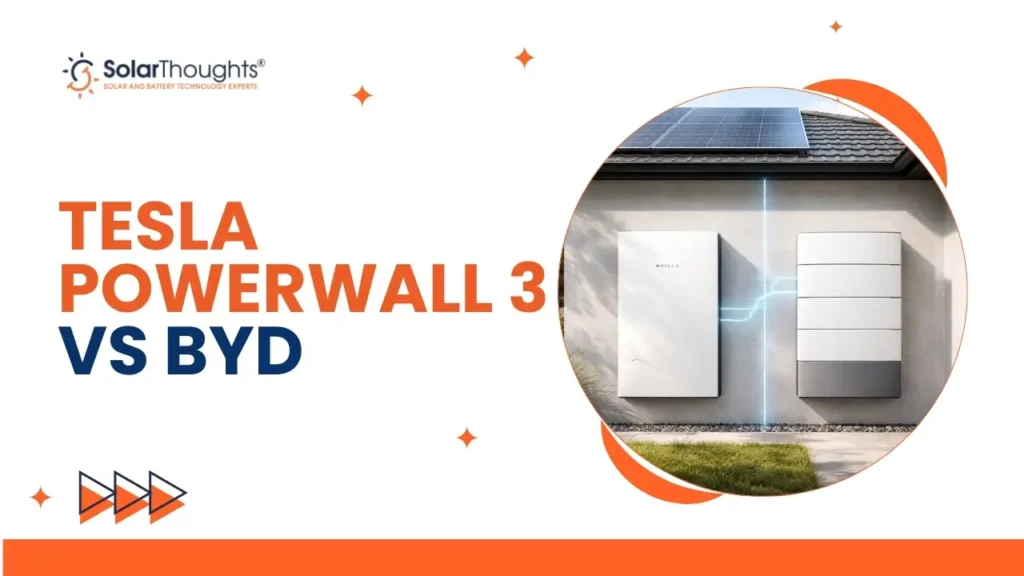
ToggleTwo of the most talked-about options right now are the Tesla Powerwall 3 and BYD batteries paired with a Fronius inverter. Both are high-quality systems, but they suit very different homes.
At SolarThoughts®, we focus on how these systems behave in real Australian houses—not just spec sheets.
Understanding Your Power Supply Comes First
Before comparing features, you need to know one thing: is your home single-phase or three-phase? This single detail has the biggest impact on which battery will work best for you.
The Challenge with Three-Phase Homes
The Tesla Powerwall 3 is a single-phase battery. That’s fine for many homes, but it becomes a limitation in larger or newer houses that run on three-phase power.
During a blackout:
- A single Powerwall can usually back up only one phase
- Covering all phases would require multiple units, which quickly becomes expensive.
BYD batteries, when paired with a Fronius hybrid inverter, handle three-phase power far more naturally. In a grid outage, this setup can back up the entire home, not just part of it.
For most three-phase homes, BYD is the more practical choice.
Single-Phase Homes: Where Tesla Shines
If your home is single-phase, the Powerwall 3 becomes very attractive.
It combines:
- Solar inverter
- Battery
- Backup capability
All in one compact unit.
This all-in-one design keeps installation tidy and helps keep costs down. Tesla also pushed the market forward by aggressively pricing the Powerwall, forcing competitors to follow.
Cost and Value in 2026
Battery prices have shifted dramatically. Today, Tesla and BYD systems sit much closer in price than they did just a few years ago.
| Feature | Tesla Powerwall 3 | BYD + Fronius |
| Best suited for | Single-phase homes | Three-phase homes |
| Inverter | Built-in | Separate hybrid inverter |
| Capacity | 13.5 kWh | Modular (2.75 kWh blocks) |
| Expansion | Fixed | Easily expandable |
Tesla keeps things simple. BYD offers flexibility if your energy needs grow over time.
Charging and Discharging Power
Discharge Strength
The Powerwall 3 can deliver up to 10 kW of power. That means you can run multiple high-draw appliances at once during a blackout without tripping the system.
This is one of Tesla’s strongest advantages.
Charging Speed
Some BYD systems can accept higher charging power from solar than Tesla allows. On cloudy days or short bursts of sun, this can help capture more energy quickly.
What Happens When the Grid Goes Down?
Tesla: Instant Backup
Tesla uses a gateway that detects outages almost instantly. Most people won’t even notice the switch—lights barely flicker, and electronics stay on.
BYD + Fronius: Safety-First Restart
This system pauses for around 20–30 seconds before restoring power. During that time, it checks the grid conditions for safety.
While less seamless, it does give homeowners a clear signal that they’re on backup power—useful for managing loads and stretching battery life.
App Control and Energy Management
Tesla App
Widely considered one of the best energy apps available. It’s simple, visual, and includes features like:
- Storm-ready battery reserve
- Automatic price-based optimisation
Fronius App
More detailed and data-rich. Ideal for homeowners who like to understand exactly where their energy is going. Manual reserve settings give you control, especially before bad weather.
Electric Vehicle Compatibility
Tesla Ecosystem
Tesla products work best together. If you own a Tesla car, charger, and Powerwall, everything lives in one app and works seamlessly.
Open Flexibility with BYD
The BYD + Fronius setup works with any EV brand. You can prioritise solar charging for your car without draining your home battery—something many households prefer.
Physical Design and Durability
Tesla Powerwall 3
- Extremely compact for its capacity
- Modern glass design
- Highly water-resistant
Tesla has demonstrated these units operating even with water surrounding them, making them suitable for areas prone to minor flooding.
BYD Modular Design
- Stackable battery blocks
- Easy to expand later.
- Capacity can grow up to ~22 kWh
If your energy use increases over time, BYD offers a smoother upgrade path.
SolarThoughts® Final Recommendation
There is no universal winner—only the right choice for your home.
Choose Tesla Powerwall 3 if:
- Your home is single-phase
- You want a clean, all-in-one system.
- You already drive a Tesla.
- You value instant backup.
- You live in a flood-prone area.
Choose BYD with a hybrid inverter if:
- Your home is three-phase
- You want room to expand storage later.
- You drive a non-Tesla EV
- You want flexibility and safety-first blackout behaviour.
Both systems are reliable, proven, and well-supported. The competition between them has pushed battery technology forward—and that benefits homeowners most.
At SolarThoughts®, we always recommend choosing based on your switchboard, your usage, and your plans, not just brand recognition.
Looking for the right home battery in Brisbane or Ipswich? Contact SolarThoughts® today and get expert advice tailored to your home.
Our Popular Services
Solar panels Brisbane | Solar Panel Installation Services | Upgrading existing Solar system | Solar Panel Repairs and Maintenance | Solar Panel Cleaning Service | Solar Battery Installations | Solar Inverter Installations