You’ve probably heard that solar panels should face north. It’s good advice, but it’s not the whole story, and blindly following it can cost you money on your power bill.
The truth is that the best direction depends on when you use power. This guide breaks down solar panel orientation in Brisbane, comparing north, east, and west with real output figures, so you can pick the direction that actually saves you the most.
Key Takeaways
- North-facing panels produce the most energy overall in Brisbane, close to 100% of the maximum.
- East and west facing panels produce around 10 to 15% less, but generate at more useful times of day for many households.
- With feed-in tariffs low, the best direction is the one that matches when you use power, not just the one with the highest total output.
Does Solar Panel Orientation Matter?
Yes, but maybe not the way you think. Orientation affects both how much energy your panels produce and when they produce it. In Brisbane, the difference between the best and worst direction is roughly 25 to 30% of total output.
North gives the most total energy. But because feed-in tariffs are now low, the smarter goal is often to produce power when you’re actually using it, which can make east or west the better financial choice.
North vs East vs West: The Brisbane Numbers
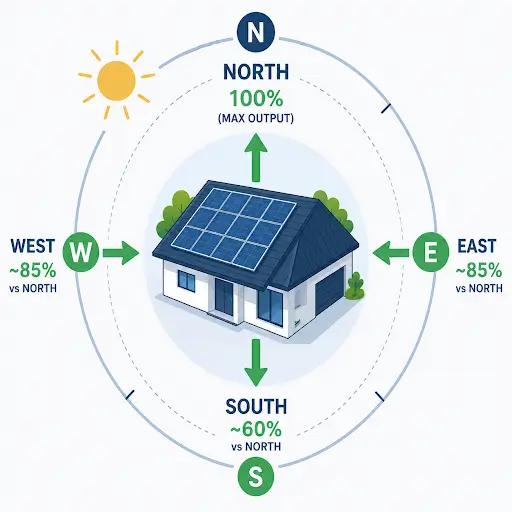
Here’s how each direction performs in Brisbane compared with a perfect north-facing setup.
| Direction | Output vs north (Brisbane) | Generates most power |
|---|---|---|
| North | ~100% (the benchmark) | Midday |
| North-east / North-west | ~95% | Late morning / early afternoon |
| East | ~85% | Morning |
| West | ~85 to 88% | Afternoon |
| South | Lowest, best avoided | Limited, spread out |
Output figures based on Brisbane orientation data. Source: SolarQuotes panel direction guide.
As you can see, east and west lose only around 10 to 15% compared with north in Brisbane, which is a small trade-off if it means generating power when you need it.
North: Best for Total Output and Daytime Users
North-facing panels catch the sun through the middle of the day, so they produce the highest total energy across the year. In Brisbane, that’s close to the maximum possible.
North suits you best if you’re home during the day, or if you have a battery to store the midday peak for later. If you can run the dishwasher, pool pump, and washing machine while the sun is high, north is hard to beat. Pairing north panels with storage is covered in our guide on choosing the right battery size.
West: Best for Afternoon and Evening Peaks
West-facing panels produce most of their power in the afternoon, peaking after midday and running strong toward sunset. They lose only around 12 to 15% overall versus north in Brisbane.
This suits the classic Queensland household that’s out during the day and home in the evening, running air conditioning as the afternoon heat builds. That’s exactly when grid power is most expensive, so generating your own then delivers real savings.
East: Best for Morning Households
East-facing panels are the mirror image, producing most in the morning. They’re ideal if your home uses a lot of power early in the day, such as morning routines, or if the east side of your roof is the only unshaded option.
The East-West Split: Steady All-Day Power
Here’s an option many people don’t consider. Putting some panels facing east and some facing west creates a flatter, all-day output: energy from sunrise, through the day, to sunset.
Total production is around 15% lower than an all-north system, but the payoff is higher self-consumption. Because the power is spread across the day, you use more of it yourself instead of exporting it cheaply. For homes without a battery, an east-west split is often the smartest layout in 2026.
Pro tip: With feed-in tariffs low, matching generation to your usage beats chasing maximum output. A west or east-west layout often saves more than a pure north system.
Not sure which layout suits your roof and habits? Get a free system design from SolarThoughts and we’ll model the best orientation for your home.
What Else Affects the Right Direction
Orientation isn’t the only factor. Keep these in mind:
- Shading. A shaded north roof can perform worse than an unshaded east or west one. Avoid trees and obstructions.
- Tilt. Panel angle matters too. Around 20 to 30 degrees works well in Brisbane. See our guide on why tilt is so important.
- Your tariff. Time-of-use plans reward generating during expensive peak periods.
- A battery. With storage, direction matters less, because you can save surplus for later.
Common Mistakes to Avoid
Chasing north at all costs. If north is shaded or faces the wrong way for your usage, it’s not automatically best.
Ignoring when you use power. The best direction depends on your daily routine, not just total output.
Forgetting about shading. Even partial shade can cost more output than a slightly worse direction.
Overlooking the east-west split. It’s often the best self-consumption layout for battery-free homes.
Avoiding south entirely on principle. South is weakest, but with cheap panels it can still be worth using leftover roof space.
Frequently Asked Questions
Does solar panel orientation matter in Brisbane?
Yes. It affects both how much power you produce and when. North gives the most, but east or west can save more depending on your usage.
Which direction is best for solar panels in Brisbane?
North for maximum total output. But west or an east-west split often saves more if you use power in the afternoon or evening.
How much less do east and west panels produce?
In Brisbane, around 10 to 15% less than north over a year, which is a modest trade-off for better-timed generation.
Should solar panels face south?
South is the weakest direction and best avoided, but with today’s low panel prices it can still be worth using spare roof space.
What is an east-west split?
Panels facing both east and west, giving flatter all-day output and higher self-consumption, ideal for homes without a battery.
Does orientation matter if I have a battery?
Less so. A battery stores surplus for later, so you can prioritise total output with a north-facing layout.
What is the best tilt for Brisbane panels?
Around 20 to 30 degrees works well. Most tiled roofs are close to this already.
Do west-facing panels help with air conditioning?
Yes. They peak in the afternoon, matching the late-day air-con load and expensive peak power rates.
Can I mix panel directions on one roof?
Yes. Splitting panels across directions can flatten output and match your usage more closely.
Does shading change the best direction?
Absolutely. An unshaded east or west roof can outperform a shaded north one, so shade often decides the layout.
Conclusion
So does solar panel orientation in Brisbane matter? Yes, but the best direction is the one that fits your life. North wins on total output and suits daytime users and battery homes. West and east-west splits often save more for households that use power in the afternoon and evening.
With feed-in tariffs low, the winning move is matching your panels to when you actually use energy. A good installer will model your roof, your habits, and your tariff to get it right.
Want the best layout for your home? Contact SolarThoughts for a free, tailored system design and we’ll orient your panels for maximum savings.