Imagine filling your car every day for close to nothing, straight from your own roof. That’s the promise of solar-integrated EV charging, and in 2026 it’s the single best reason to buy a smart charger.
This guide explains solar mode EV charging in plain terms: what it is, how a smart charger pulls surplus power from your panels, what you need for it to work, and how much it can save a Brisbane home now that feed-in tariffs are low.
Key Takeaways
- Solar mode EV charging uses surplus power from your rooftop panels to charge your car instead of exporting it for a few cents.
- It works by detecting your excess solar and adjusting charging power to match, sometimes down to as little as 1.4kW.
- To use it, you need a compatible smart charger plus the right inverter, and often a smart meter or battery.
What Is Solar Mode EV Charging?
Solar mode is a charging setting that tells your EV charger to use only, or mostly, the surplus solar your panels are producing. Instead of sending that extra power to the grid for a small feed-in payment, the charger diverts it to your car.
The result is close to free driving. You’re using energy worth around 30 cents per kilowatt-hour to you, rather than exporting it for the few cents most Queensland plans now pay.
This matters more than ever. With feed-in tariffs low, self-consumption is where the savings are, and an EV is a big, flexible load that soaks up surplus solar beautifully.
How Solar Mode Actually Works
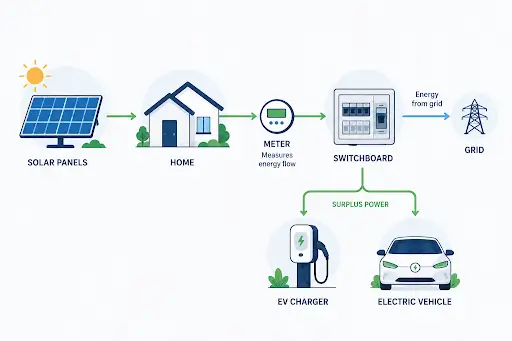
A solar-capable charger constantly watches the flow of power at your switchboard through a smart meter or your inverter. When your panels generate more than your home is using, the charger sends that surplus to the car.
The clever part is that it adjusts in real time. As a cloud passes or the kettle switches on, the available surplus drops, and the charger dials its power down to match, in fine steps. The Fronius Wattpilot, for example, adjusts from as low as 1.38kW up to 22kW and even switches automatically between single and three phase to make the most of whatever the sun is giving.
You’ll usually get a choice of modes, which is where it gets practical.
Charging Modes Explained
| Mode | What it does | Best for |
|---|---|---|
| Solar / Eco mode | Charges only from surplus solar | Cheapest charging, when you’re not in a hurry |
| Boosted / hybrid mode | Tops up with cheap grid power if solar is low | Making sure the car is ready by a set time |
| Scheduled mode | Charges during off-peak hours | Homes on a time-of-use tariff |
| Next Trip mode | Guarantees a set range by a set time | Reliable charging for a known journey |
Most drivers run solar mode on days they’re home, then switch to a scheduled or next-trip mode when they need a guaranteed charge. Our guide to charging your EV with solar energy covers day-to-day use.
What You Need to Make It Work
Solar mode isn’t automatic with any charger. You need a few pieces working together:
- A solar-capable smart charger, such as the Fronius Wattpilot Flex or GoodWe HCA G2.
- A compatible inverter. The Fronius Wattpilot works best with a Fronius inverter and smart meter, while the GoodWe HCA integrates with GoodWe inverters and batteries.
- A smart meter or battery in many cases, so the system can measure your surplus accurately. GoodWe’s full solar-only charging needs a GoodWe battery.
- Enough solar generation. The bigger your system, the more surplus there is to charge the car during the day.
Pro tip: If you’re buying panels and an EV charger together, choose them as a matched system. Pairing the charger with the same brand of inverter unlocks the smoothest solar charging.
Want a charger and solar setup that work as one? Get a free assessment from SolarThoughts and we’ll match the right gear to your home.
How Much Can Solar Mode Save?
The saving comes from the gap between what your solar is worth exported versus self-consumed. Export earns a few cents. Charging your car with it saves you the 30 cents or more you’d otherwise pay the grid at night.
For a household that charges mostly from daytime surplus, that can mean hundreds of dollars a year in avoided charging costs, on top of your normal solar savings. It also shortens the payback on both your solar system and your charger. See current export rates in our guide to the best feed-in tariffs in Queensland.
Common Mistakes to Avoid
Assuming any charger does it. Only chargers with true solar-surplus functionality can charge from excess solar.
Mismatching brands. A charger and inverter from different ecosystems may not talk to each other for full solar mode.
Forgetting the smart meter. Without accurate metering, the charger can’t measure your surplus properly.
Undersizing your solar. A small system may not produce enough daytime surplus to charge the car meaningfully.
Charging at the wrong time. Running solar mode overnight defeats the purpose. Charge when the sun is up.
Frequently Asked Questions
It’s a setting that charges your car using surplus power from your rooftop solar instead of exporting it to the grid for a low feed-in rate.
It measures the power flow at your switchboard through a smart meter or your inverter, then matches charging to the surplus.
Not always. Many chargers use daytime surplus directly. GoodWe’s full solar-only mode does require a GoodWe battery.
No. Only chargers with solar-surplus functionality, like the Fronius Wattpilot or GoodWe HCA, can do it properly.
It varies, but charging from surplus solar can save hundreds a year compared with buying grid power at night.
It can, because it matches the available surplus. Boosted modes add grid power when you need a faster or guaranteed charge.
A compatible one. Fronius chargers pair best with Fronius inverters, and GoodWe chargers with GoodWe inverters.
Yes. Scheduled and next-trip modes let you charge on cheap off-peak power or guarantee a set range by a set time.
Yes, more than ever. The lower your feed-in tariff, the more you save by self-consuming solar in your car.
Yes. More generation means more daytime surplus, so more of your driving runs on free solar.
Conclusion
Solar mode EV charging is the feature that turns rooftop sunshine into car fuel. By using your surplus solar instead of exporting it, you charge for close to nothing, which is exactly the right move now that feed-in tariffs are low.
To get it working you need a solar-capable charger, a compatible inverter, and usually a smart meter, ideally chosen as a matched set. Do that and every sunny day tops up your car for next to nothing.
Want to charge your EV on your own sunshine? Contact SolarThoughts for a free solar and EV charger assessment and we’ll design a system that works together.