You’ve decided solar makes sense for your Brisbane home. Then a practical question stops you: will the system you want even fit on your roof? It’s one of the most common things homeowners ask us before an installer ever climbs a ladder.
Table of Contents
ToggleThe good news is that the maths is simple once you know the numbers. This guide breaks down exactly how much roof space you need for solar panels in 2026, space by system size, the real area each panel takes, and how to tell at a glance whether your roof is ready.
How Much Roof Space Do You Need for Solar Panels?
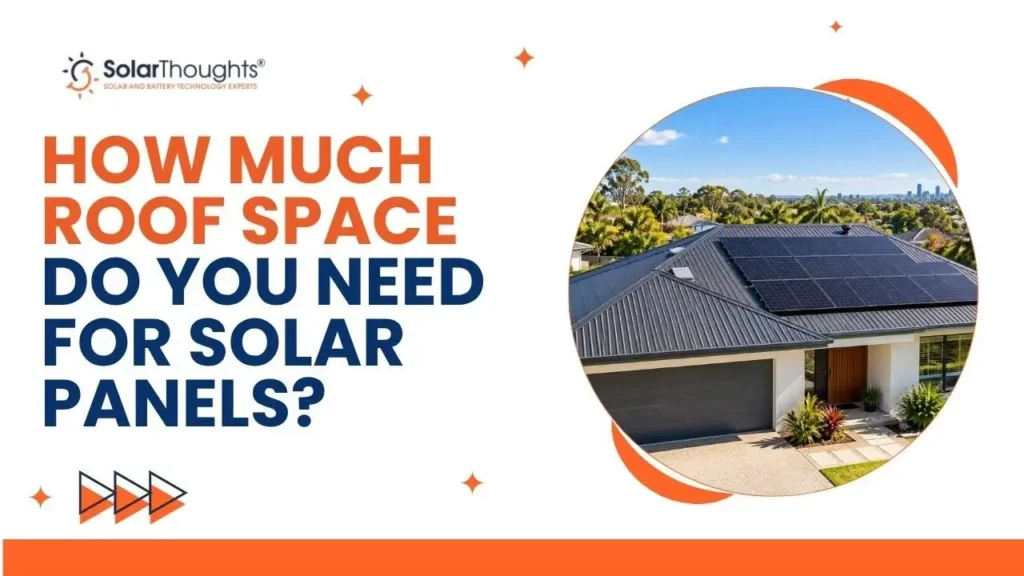
As a rule of thumb, you need about 4 to 5 square metres of usable roof space per kilowatt of solar. So a standard 6.6kW system needs roughly 28 to 30 square metres, which is comfortably within reach for most Brisbane homes.
That figure comes from the size of the panels themselves. A typical residential panel in 2026 measures around 1.7 metres by 1.1 metres, which is close to 1.9 square metres each. Once you add mounting rails, ventilation gaps, and edge clearances, installers plan for about 1.8 to 2 square metres per panel.
The important word is “usable.” Your total roof might be 150 square metres, but only part of it faces the right way, sits free of shade, and stays clear of vents and edges. We’ll come back to that, because it’s where most surprises happen.
How Much Roof Space Does Each Solar Panel Take Up?
Each modern residential solar panel takes up roughly 1.8 to 2 square metres of roof once installation gaps are included. The panel itself is about 1.9 square metres, and the extra allowance covers the rails and spacing a safe install requires.
Panel wattage matters here too. Most panels sold in Australia in 2026 are rated between 400W and 440W. A higher-wattage panel produces more power from the same physical footprint, so better panels let you fit more systems onto a tight roof. That’s why two homes with identical roof space can end up with different system sizes.
If you want to go deeper on panel types and how they differ, our guide on which type of solar panel is best for your home explains the trade-offs between efficiency and cost.
How Much Roof Space Do You Need by System Size?
The table below shows the usable roof space needed for the most common Brisbane system sizes, based on 440W panels. These map directly to the residential systems we install, from a compact 6.6kW setup up to a large 19.8kW array.
| System size | Panels (approx) | Usable roof space | Best suited to |
|---|---|---|---|
| 6.6kW | 15 panels | 28 to 30 m² | Smaller homes, modest daytime use |
| 8.8kW | 20 panels | 38 to 40 m² | Average family homes |
| 10.56kW | 24 panels | 45 to 48 m² | Larger homes, air-con or pool |
| 13.2kW | 30 panels | 56 to 60 m² | High usage, EV charging |
| 19.8kW | 45 panels | 85 to 90 m² | Very large or all-electric homes |
As a quick sense check, a typical double garage roof is around 36 square metres, which is roughly enough for a 6.6 to 8.8kW system on its own. Most Brisbane homes have far more than that once the main roof is included.
If you already know the size you want, our 6.6kW system page and 13.2kW system page break down pricing and output for those options.
How Do You Work Out if Your Roof Is Big Enough?
You can get a reliable estimate in four steps before an installer visits. It takes five minutes with a tape measure or a satellite view of your home.
- Decide your system size. Start from your power bill and how much you use, then pick a target like 6.6kW or 10kW. Our guide on how many solar panels you need to run an air conditioner helps if cooling drives your bill.
- Find the space needed. Use the table above, or multiply your target by 4.5 square metres per kW for a quick figure.
- Measure your usable roof. Focus on the north, east, and west faces that are clear of shade and large obstructions.
- Compare the two numbers. If your usable space is equal to or greater than the space needed, you’re set. If it’s tight, higher-wattage panels can close the gap.
Keep in mind this is a planning estimate, not a design. A professional assessment accounts for your exact roof pitch, structural condition, and how panels can be grouped to avoid shade. It’s worth confirming your home is ready, which our guide on whether your home is ready for solar panels walks through.
What Else Affects How Many Panels Fit on Your Roof?
Raw area is only the starting point. Several real-world factors shrink the space you can actually use, and ignoring them is how homeowners end up disappointed with a smaller system than they expected.
Shading is the biggest one. A north roof shaded by a tree or a neighbour’s second storey can be worth less than an unshaded east or west roof, so installers often skip shaded sections entirely. Roof obstructions matter too, because vents, skylights, antennas, chimneys, and air-conditioning units all break up the clean runs of space that panels need.
Orientation and roof faces shape the layout as well. Your panels may need to spread across two or three faces of the roof to catch the sun through the day, and each face needs its own clear area. Finally, safety setbacks apply, since Australian install standards require clearance around the edges of the roof, which quietly removes usable space from every face.
This is exactly why total roof area and usable roof area are rarely the same number. Orientation also affects how much you get from the space, and our guide on why the tilt of your solar panels matters explains how angle changes output.
Does Your Roof Type Change How Much Space You Need?
Roof type doesn’t change the space each panel needs, but it does affect how easily panels can be laid out and mounted. The square-metre figures above still apply whether you have tin or tile.
Tin and metal roofs are the simplest to work with, since panels clamp neatly to the sheeting and installers can use most of the available run. Tile roofs take a little more care because each tile under a mounting point needs the right bracket, though the usable area stays much the same. Our guides on installing solar on a tile roof and a flat roof cover the specifics.
Flat roofs are the one real exception to the space rule. On a flat roof, panels are usually mounted on tilt frames so they sit at an angle, and angled rows cast shadows on the row behind them. To avoid that, installers space the rows apart, which means a flat roof needs noticeably more area for the same system size. Our comparison of tilted versus flat panels explains the gap.
What if Your Roof Space Is Limited?
A tight roof doesn’t mean you have to give up on solar, or settle for a token system. A few practical options let you get more power from less space.
- Choose high-efficiency panels. Premium panels produce more watts from the same footprint, so you fit more system into a small area.
- Use multiple roof faces. Splitting panels across north, east, and west roofs opens up space you might not have counted.
- Prioritise an unshaded area. A smaller array in full sun often beats a larger one fighting shade.
- Add a battery later. If you can’t fit a huge system, storing what you do generate helps you use more of it. Our guide on adding a battery to an existing solar system covers this.
The right design turns a limited roof into a system that still cuts your bills hard. That’s a conversation worth having with an installer who will model your actual roof rather than quote a one-size-fits-all package. Get a free roof assessment from SolarThoughts and we’ll tell you exactly what fits.
How Much Does the Roof Space You Need Cost to Fill?
The space is only half the question. The other half is what a system that size costs, and in Brisbane the numbers are attractive thanks to strong sun and federal rebates. A 6.6kW system that fits in around 30 square metres is the most popular choice because it balances cost, output, and roof space well.
Larger systems need more roof but deliver far more power, which suits homes with air conditioning, a pool, or an EV. Our guide on how much solar panels cost in Brisbane breaks down current pricing by size, so you can match your available roof space to a budget.
One more factor ties the two together. Bigger systems may need three-phase power to export fully, so if you’re planning a large array, it’s worth checking your supply early. Our guide on single phase versus three phase explains when that matters.
Common Mistakes to Avoid
Measuring total roof area instead of usable area. The figure that matters is the clear, unshaded, correctly facing space, which is always smaller than your whole roof.
Forgetting about shade. A roof that looks huge can lose most of its value to a single tree or a neighbouring building, so assess shade before counting square metres.
Ignoring obstructions. Vents, skylights, and air-conditioning units break up panel runs and reduce how many panels actually fit.
Assuming a flat roof fits the same as a pitched one. Tilt-frame rows need spacing to avoid shading each other, so flat roofs need more area for the same output.
Maxing out the roof without checking your supply. A very large array may need a three-phase connection to export fully, which is cheaper to plan for up front than to retrofit.
Frequently Asked Questions
How much roof space do you need for a 6.6kW solar system?
About 28 to 30 square metres of usable roof, which is roughly 15 panels at 440W each. That fits comfortably on most Brisbane homes.
How many square metres does one solar panel take?
Around 1.8 to 2 square metres once mounting rails and spacing are included. The panel itself is close to 1.9 square metres.
How much roof space per kW of solar?
Plan for about 4 to 5 square metres of usable roof per kilowatt as a quick estimate before a professional design.
How many solar panels fit on an average Australian roof?
Most homes can fit a 6.6kW to 10kW system, roughly 15 to 24 panels, depending on roof shape, shading, and obstructions.
Does a bigger roof mean I can have a bigger system?
Only if the extra space is usable. Shade, orientation, and obstructions matter more than total roof size.
Can I fit solar on a small roof?
Yes. High-efficiency panels and using multiple roof faces let you fit a worthwhile system on a limited roof.
Do solar panels need space around them?
Yes. Australian install standards require clearance around roof edges, which reduces the usable area on every face.
How much roof space does a 10kW system need?
Around 43 to 48 square metres, or roughly 23 to 24 panels at 440W, depending on panel choice.
Does roof type affect how much space I need?
Tile and tin roofs need about the same space. Flat roofs need more because tilt-frame rows must be spaced to avoid shading.
What if part of my roof is shaded?
Installers usually design around shaded sections, placing panels on clear faces and sometimes using panel-level optimisers to limit losses.
Conclusion
Working out how much roof space you need for solar panels comes down to one simple ratio: about 4 to 5 square metres per kilowatt, or roughly 30 square metres for a popular 6.6kW system. From there it’s a matter of checking that your usable space, the clear and correctly facing part of your roof, matches the system you want.
Shade, obstructions, roof type, and safety setbacks all shape the final layout, which is why a professional assessment beats a rough estimate every time. Get the design right and even a modest roof can deliver a system that cuts your power bills for decades.
Want to know exactly what fits on your roof? Contact SolarThoughts for a free, no-obligation roof assessment and we’ll size the right system for your Brisbane home.